WebAssembly Binary Reverse Engineering: Decompiling WASM, Extracting Secrets, and Exploiting Linear Memory
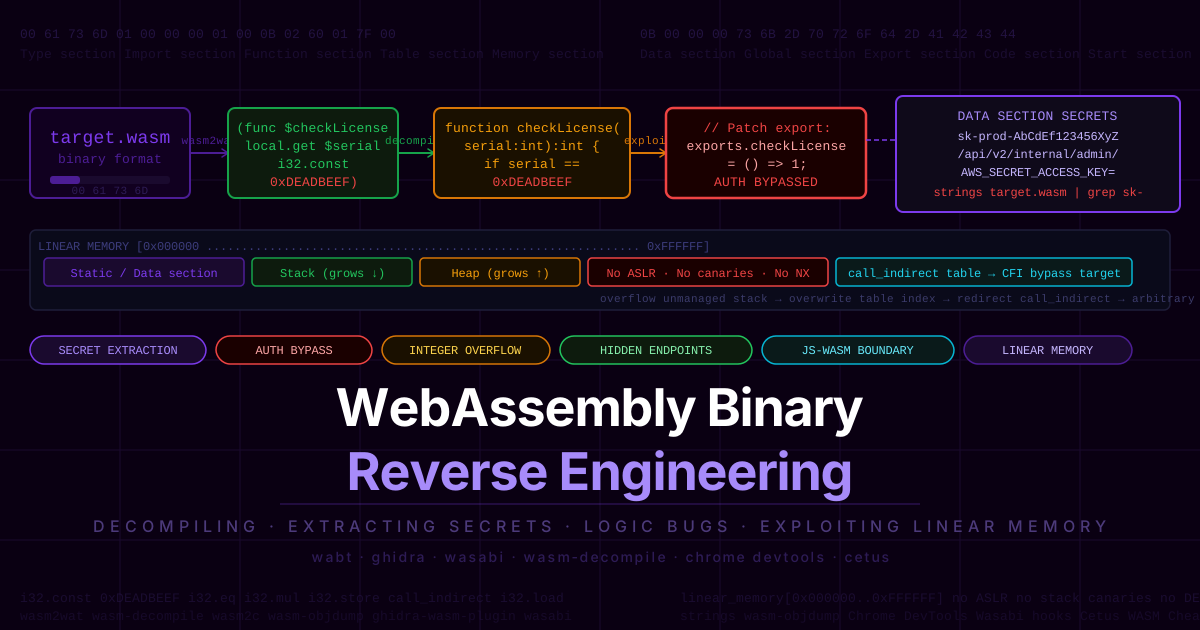
WebAssembly (WASM) has quietly become one of the most security-relevant technologies on the modern web. It powers everything from high-performance design tools and games to crypto wallets, DRM components, and proprietary business logic that companies don’t want to expose as plain JavaScript.
From an attacker’s perspective, that last point is exactly the problem: teams often treat a .wasm file like a protective wrapper, something “too low-level to bother with.” In reality, WASM is frequently where the most sensitive material ends up living: hardcoded API keys, license checks, encryption routines, feature flags, even privileged endpoints and admin logic.
This article walks through a practical, end-to-end workflow for reverse engineering WASM binaries and turning findings into real-world security outcomes. We’ll cover how to inspect and decompile modules, where secrets hide (and how to extract them even when “obfuscated”), and how linear memory and boundary bugs can open the door to serious exploitation.
WASM was designed as a compilation target for languages like C/C++, Rust, and Go, delivering near-native performance in a sandboxed environment (typically the browser). That performance is why teams ship it. But the security posture of WASM in production is often shaped more by developer assumptions than by reality.
The common misconception
A lot of applications ship WASM under the belief that:
- it’s “binary,” so it’s harder to reverse,
- scanners and typical web tooling won’t understand it,
- it won’t be inspected the way JavaScript is.
And that’s partially true, automated web scanners generally don’t inspect WASM effectively, and many pentesters still treat it as a black box. But reverse engineering WASM is very feasible, and the format is structured in ways that make analysis surprisingly systematic.
Why sensitive logic ends up in WASM
Teams commonly move “important” logic into WASM because it:
- runs faster than JS,
- can reuse existing native code,
- feels more protected.
In practice, it often becomes a single file containing everything you want as an attacker: secrets, logic, and state.
WASM Internals That Matter for Security Work
You don’t need to become a compiler engineer to reverse engineer WASM effectively. But you do need to understand a few core concepts.
Unlike PE/ELF binaries, WASM is self-describing and broken into clear sections. Every .wasm begins with the magic header: \\\\x00asm
That alone makes it easy to identify and validate in traffic captures.
The Data Section: where secrets often live
One of the highest-value parts of WASM for security research is the Data Section (0x0B). This is where:
- string literals,
- static buffers,
- hardcoded values,
- pre-initialized structures
often end up.
If someone embedded an API key, a hidden endpoint, a token prefix, or “temporary debug credentials,” there’s a good chance it shows up here, sometimes in plain text, sometimes lightly transformed.
Linear Memory: The Exploitation Surface Most People Ignore
WASM does not use native memory addresses the way x86 binaries do. Instead, it operates on a flat byte array called linear memory, indexed via i32 offsets.
This model is central to exploitation and data extraction because it tends to be:
- deterministic,
- observable from JavaScript,
- easier to scan or tamper with than people expect.
Security implications of linear memory
In many real deployments (especially those compiled via Emscripten or ported from C/C++), WASM inherits classic unsafe behaviors:
- unchecked reads/writes,
- integer overflow conditions,
- stack/heap layout assumptions.
And crucially, several mitigations that defenders rely on in native exploitation contexts may not apply in the same way:
- No ASLR-like behavior in linear memory addressing (offsets are stable)
- No stack canaries by default in many toolchains
- A shared memory model where overwriting adjacent areas can corrupt logic/state
The result: if unsafe memory behavior makes it into a WASM module, exploitation can be very practical, even in a browser context.
The Core Tool Arsenal (Static + Dynamic)
A strong workflow combines static analysis (understanding what the module contains) with dynamic analysis (observing what happens at runtime).
Static analysis tools
- WABT (WebAssembly Binary Toolkit)
wasm2wat: converts.wasmto readable text formatwasm-decompile: produces a C-like pseudocode representationwasm-objdump: section-level inspection and metadata dumps
- Ghidra + WASM plugin
- useful for complex modules and deeper structural analysis
- strings
- the fastest “first pass” for secret-hunting and endpoint discovery
Dynamic analysis tools
- Chrome DevTools
- breakpoints in the
[wasm]section under Sources - runtime inspection of exports, imports, and memory buffers
- breakpoints in the
- Wasabi
- dynamic instruction-level instrumentation (great for tracing)
- Cetus
- a WASM “Cheat Engine”-style extension for searching/modifying linear memory live
A simple rule of thumb: start with strings + wasm-decompile, then move to DevTools once you know what to look for.
Phase 1: Extracting Hardcoded Secrets
If you’re doing bug bounties or pentests and want fast wins, start here. Teams routinely embed secrets in WASM, sometimes unintentionally, sometimes because they assume compilation is “obfuscation enough.”
A simple approach is:
strings target.wasm | grep -iE '(api[_-]?key|secret|token|password|bearer|sk-|pk-|https://|/api/v|admin|debug)'
What you’re looking for:
- API keys and token fragments (
sk-,pk-,Bearer) - internal URLs or staging endpoints
- feature flags and debug routes
- admin-only handler names
Even if you don’t get a complete secret, you often get enough context to pivot into further testing (e.g., discovering hidden API base URLs, environment names, or privileged endpoints).
“Obfuscation” in WASM: XOR and Similar Tricks
Sometimes developers try to “hide” strings with simple transformations, XOR is a classic. The pattern typically looks like a loop that:
- reads bytes from a data region
- applies
byte ^ KEY - writes the result into another buffer
The weakness is predictable: the key is usually in the same binary, and offsets are stable. Once you identify:
- the data offset,
- the expected length,
- the XOR key,
you can extract and decode quickly with a script.
If you find the key and offset via static analysis, you can extract the plaintext secret using a short Python script:
import struct

with open('target.wasm', 'rb') as f:
    raw = f.read()

# Known variables from decompiled output
DATA_OFFSET = 0x39f1e  # Start of Data section (0x0B)
SECRET_OFFSET = 0x1200 # Offset within linear memory
KEY = 0xAB           # Hardcoded XOR key

# Extract and decode
secret_bytes = raw[DATA_OFFSET + SECRET_OFFSET : DATA_OFFSET + SECRET_OFFSET + 32]
decoded = bytes([b ^ KEY for b in secret_bytes])
print(f'Decoded secret: {decoded}')
This is important in real engagements because it’s often just enough to bypass the developer’s assumption that “we didn’t store it in plaintext.”
Dynamic Secret Extraction: When Secrets Appear Only at Runtime
Some applications avoid storing secrets as plain strings and instead:
- decrypt them at runtime,
- assemble them from parts,
- fetch them and store temporarily in memory.
That’s where dynamic analysis shines.
Because WASM memory is exposed through the module’s exported memory buffer (in many setups), you can sometimes scan memory for interesting patterns once the app is running.
A practical approach is to:
- get a handle to the WASM instance/module
- read the
memory.buffer - decode it and pattern match likely secrets
Example: Scanning Linear Memory via Chrome DevTools
// 1. Get a reference to the WASM instance (often exported globally)
const wasmInstance = window.__wasmModule || window.Module;

// 2. Access the linear memory buffer
const mem = new Uint8Array(wasmInstance.exports.memory.buffer);

// 3. Scan the raw bytes for known secret patterns
function scanMemoryForSecrets() {
  const text = new TextDecoder().decode(mem);
  const matches = [...text.matchAll(
    /(?:Bearer |sk-|pk-|api.?key|secret).{8,64}/gi
  )];
  matches.forEach(m => console.log('[SECRET FOUND]', m[0]));
}
scanMemoryForSecrets();
This becomes especially powerful when secrets exist briefly (e.g., after a decrypt function runs) and never touch JavaScript logs.
Phase 2: Finding Logic Bugs and Auth Bypasses
Once secrets are handled, the next big category is logic. WASM doesn’t magically protect business logic. If anything, it makes some logic more tempting for developers to “hide,” including authentication and licensing.
In wasm-decompile pseudocode, watch for:
- hardcoded bypass conditions
- “special user” IDs
- debug flags that short-circuit checks
- role checks that allow alternative paths
A common failure mode is a normal check plus a “temporary” exception, something like “if user_id == 0, treat as admin,” which survives into production.
Example: The Short-Circuit Logic Bug
Using wasm-decompile, this pattern is highly visible in the generated pseudocode:
function isAdmin(user_id:int):int {
  var role:int = getUserRole(user_id);

  if (role == 1) { return 1; }      // Normal admin check
  if (user_id == 0) { return 1; }   // BUG: Short-circuit bypass!

  return 0;
}
Runtime patching mindset
Because WASM exports functions (and JS calls them), researchers sometimes demonstrate impact by overriding calls or patching behavior around them. Even when direct reassignment of exports isn’t possible as a true write (depending on how the object is exposed), the broader concept holds: the boundary between JS and WASM is frequently where control and visibility exist.
The point for security reporting isn’t “the attacker will always monkeypatch your app in DevTools”, it’s that if critical security decisions are happening client-side (even in WASM), they are not trustworthy.
Phase 3: Linear Memory Exploitation and Integer Overflows
WASM modules compiled from C/C++ and similar languages can carry over classic bug classes:
- out-of-bounds reads/writes
- integer overflow affecting length calculations
- unsafe pointer arithmetic translated into linear memory offsets
A high-impact boundary issue: JS Number → WASM i32 truncation
JavaScript uses 64-bit floating Number. WASM functions often expect i32. If an application passes user-controlled numbers from JS into WASM without strict validation, large values can truncate in unexpected ways.
Example conceptually:
- JS passes
4294967297(0x100000001) - WASM interprets it as
i32, truncating to1
That mismatch can create:
- length confusion,
- index bypasses,
- offset manipulation,
- “impossible” values that defeat validation logic written with JS assumptions.
Out-of-bounds reads that become secret dumps
If there’s a function that reads memory using a user-controlled offset without bounds checking, you can sometimes use it as a memory oracle:
- iterate offsets
- observe returned values
- reconstruct strings or structured secrets
This is one of the clearest “security payoff” paths: turning a memory safety flaw into direct data disclosure.
Phase 4: Attacking the JavaScript–WASM Boundary
Even if the WASM itself looks clean, the integration layer can be the weak link.
Import hooking: intercept data before it leaves
WASM modules call host functions via imports. Those imports are defined by JavaScript at instantiation time. If you can intercept or replace imports (in a test harness, in a compromised integration, or during analysis), you can log sensitive buffers before they’re sent out.
This technique is powerful for:
- catching plaintext before encryption
- observing serialized payloads
- identifying hidden telemetry or anti-tamper logic
Example: Hooking Imports at Instantiation
By replacing the import functions before the WASM module is instantiated, you can log data flowing from WASM back to JavaScript:
const hookedImports = {
  env: {
    js_send_data: (ptr, len) => {
      // Read the data directly from the WASM memory buffer
      const mem = new Uint8Array(wasmMemory.buffer, ptr, len);
      const data = new TextDecoder().decode(mem);

      console.log('[INTERCEPTED OUTBOUND]', data);
      // Optionally modify the data or drop the request here
    }
  }
};

// Instantiate the module with our hooked environment
WebAssembly.instantiateStreaming(fetch('app.wasm'), hookedImports);
emscripten_run_script and script execution risks
Emscripten exposes functions that allow WASM to execute JavaScript strings. If user input can influence those strings, the outcome can resemble XSS, except it may bypass many traditional controls because the flow happens through the WASM call chain.
For defenders, this reinforces an uncomfortable truth: visibility tools and WAF logic that assume “all risky behavior is in JS” can be blind to WASM-driven execution paths.
Conclusion
WebAssembly is one of the last major blind spots in many web security programs. Not because it’s impenetrable, but because teams underestimate how analyzable and testable it is.
When applications rely on WASM to “hide” secrets, enforce licensing, or implement authentication logic on the client side, they frequently create a perfect storm:
- valuable data embedded in predictable sections,
- logic that is reversible with the right tools,
- memory models that can enable classic bug classes,
- security tooling that isn’t watching closely.
A disciplined WASM workflow, strings → section inspection → decompile → DevTools breakpoints → memory analysis, can consistently uncover issues that automated scanners never will.