What is Weak SSL/TLS Cipher Suites? Ways to Exploit, Examples and Impact
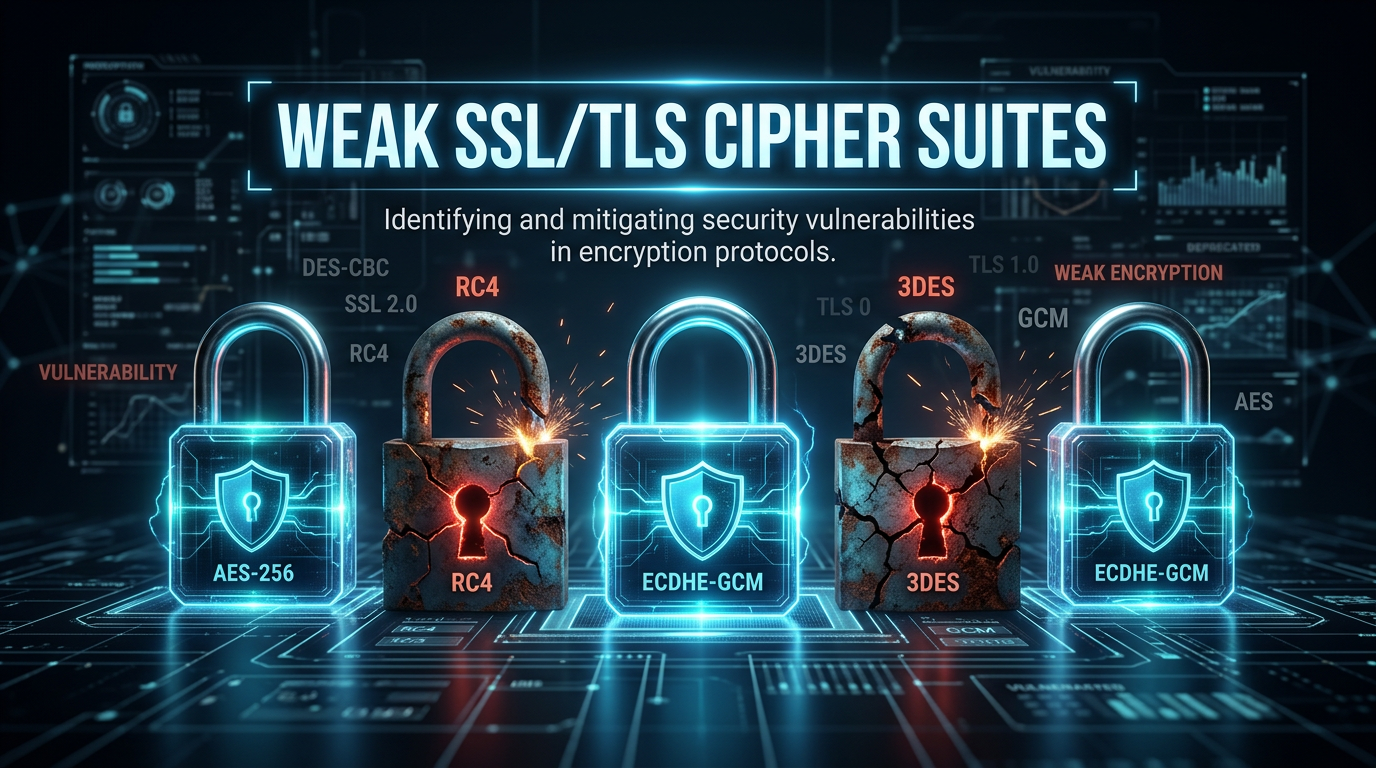
In the modern landscape of web security, having an SSL/TLS certificate is no longer the finish line for data protection; it is merely the starting point. While the padlock icon in a browser signifies that a connection is encrypted, the strength of that encryption depends entirely on the underlying cipher suites configured on the server. If a server supports weak or outdated cipher suites, attackers can bypass encryption, intercept sensitive data, and compromise user sessions. Understanding what makes a cipher suite "weak" and how these vulnerabilities are exploited is essential for any cybersecurity professional or system administrator.
Understanding SSL/TLS Cipher Suites
Before diving into the vulnerabilities, we must define what a cipher suite actually is. A cipher suite is a standardized set of instructions that helps a client (like a browser) and a server communicate securely during the SSL/TLS handshake. It defines four critical components for the connection:
- Key Exchange Algorithm: Determines how the client and server agree on a shared secret key (e.g., Diffie-Hellman or ECDHE).
- Authentication Algorithm: Verifies the identity of the server (and sometimes the client) using certificates (e.g., RSA or ECDSA).
- Bulk Encryption Algorithm: The symmetric encryption used to encrypt the actual data being sent (e.g., AES or ChaCha20).
- Message Authentication Code (MAC) Algorithm: Ensures the integrity of the data, proving it hasn't been tampered with in transit (e.g., SHA-256).
A typical cipher suite string looks like this: TLS_ECDHE_RSA_WITH_AES_256_GCM_SHA384.
In this example, ECDHE is the key exchange, RSA is the authentication, AES_256_GCM is the bulk encryption, and SHA384 is the hashing algorithm for integrity. If any of these components are outdated or mathematically broken, the entire suite is considered weak.
Why Some Cipher Suites are Considered Weak
A cipher suite is labeled "weak" if it uses algorithms that have been deprecated by the security community or have known mathematical flaws that allow for practical attacks. There are several reasons why a suite might be categorized this way:
Outdated Algorithms (RC4, 3DES, MD5)
Algorithms like RC4 (Rivest Cipher 4) were once widely used because of their speed. However, researchers discovered significant biases in the RC4 keystream that allow attackers to recover plaintext from encrypted traffic. Similarly, 3DES (Triple DES) is now considered weak because it uses a 64-bit block size, making it vulnerable to "birthday attacks" like SWEET32. MD5 and SHA-1 are also considered weak due to collision vulnerabilities, where two different inputs produce the same hash output.
Insufficient Key Lengths
Encryption is only as strong as the work required to break it. If an RSA key is 1024 bits or less, modern computing power can feasibly factor the prime numbers and recover the private key. Current standards require at least 2048-bit RSA keys or 256-bit Elliptic Curve (ECC) keys.
Lack of Forward Secrecy
Cipher suites that do not support Perfect Forward Secrecy (PFS) are inherently riskier. PFS ensures that even if a server's private key is compromised in the future, past recorded traffic cannot be decrypted. Suites that use static RSA for key exchange (e.g., TLS_RSA_WITH_AES_128_CBC_SHA) do not provide forward secrecy. If an attacker captures your traffic today and steals your server's private key next year, they can decrypt all that old data.
How to Identify Weak Cipher Suites
Identifying weak configurations is a core part of infrastructure reconnaissance. Tools like Jsmon help organizations maintain visibility over their external assets, but for a deep dive into specific SSL configurations, technical professionals often use command-line utilities.
Using Nmap for SSL Enumeration
The nmap network scanner includes a powerful script called ssl-enum-ciphers that connects to a target and lists all supported suites, even grading them based on their strength.
nmap --script ssl-enum-ciphers -p 443 <target-ip>
The output will look something like this:
PORT    STATE SERVICE
443/tcp open  https
| ssl-enum-ciphers:
|   TLSv1.0:
|     ciphers:
|       TLS_RSA_WITH_RC4_128_SHA (rsa 2048) - C
|       TLS_RSA_WITH_3DES_EDE_CBC_SHA (rsa 2048) - C
|     compressors:
|       NULL
|     cipher preference: client
|_  least strength: C
In this output, the "C" grade indicates a weak configuration because of the presence of RC4 and 3DES.
Using testssl.sh for Deep Analysis
For a more comprehensive report, testssl.sh is a popular open-source tool that checks for vulnerabilities like Heartbleed, POODLE, and Logjam while listing cipher suites in a color-coded format.
./testssl.sh https://example.com
Common Exploits Targeting Weak Ciphers
Attackers don't just look at weak ciphers for fun; they use them as entry points for sophisticated attacks. Here are some of the most famous exploits targeting weak SSL/TLS configurations.
1. The POODLE Attack (Padding Oracle On Downgraded Legacy Encryption)
POODLE (CVE-2014-3566) targets the older SSL 3.0 protocol, but it also affects TLS when servers allow a "downgrade" to SSL 3.0. It exploits the way block ciphers in CBC (Cipher Block Chaining) mode handle padding. By forcing a browser to downgrade and then manipulating the padding of encrypted packets, an attacker can decrypt sensitive cookies (like session tokens) byte-by-byte.
2. The BEAST Attack (Browser Exploit Against SSL/TLS)
BEAST targets TLS 1.0 and specifically the CBC mode of encryption. It relies on a vulnerability in the Initialization Vector (IV) used in the encryption process. Because the IV for a block was predictable in TLS 1.0, an attacker could perform a chosen-plaintext attack to decrypt traffic. This is why modern configurations prioritize GCM (Galois/Counter Mode) over CBC.
3. SWEET32: Attacking 64-bit Block Ciphers
SWEET32 (CVE-2016-2183) is a birthday attack that targets 64-bit block ciphers like 3DES and Blowfish. Because the block size is small, after about 32GB of data has been transferred over the same connection, the probability of a block collision becomes very high. An attacker observing this traffic can use the collision to recover plaintext data, such as secure session cookies.
4. Logjam and FREAK: The Export-Grade Nightmare
In the 1990s, US export laws restricted the strength of cryptography that could be shipped overseas, leading to "export-grade" ciphers with very short keys (e.g., 512-bit Diffie-Hellman). Logjam and FREAK are vulnerabilities where a modern server still supports these weak export-grade keys. An attacker can perform a Man-in-the-Middle (MitM) attack, tricking the server and client into using the 512-bit key, which can then be cracked in real-time using precomputed tables.
Real-World Impact of Weak SSL/TLS Configurations
The impact of supporting weak cipher suites ranges from technical compromise to regulatory failure:
- Data Interception: Attackers can read sensitive information like passwords, credit card numbers, and personal identity information (PII) as it travels across the network.
- Session Hijacking: By decrypting session cookies via attacks like POODLE or BEAST, an attacker can impersonate a logged-in user and take over their account.
- Compliance Violations: Standards like PCI DSS (Payment Card Industry Data Security Standard) and HIPAA (Health Insurance Portability and Accountability Act) strictly forbid the use of weak ciphers and outdated protocols like TLS 1.0. Failing an audit can lead to massive fines.
- Loss of Trust: Modern browsers like Chrome and Firefox now display "Not Secure" warnings or block connections to sites using severely outdated encryption, driving away users.
How to Prevent and Remediate Weak Cipher Suites
Securing your infrastructure requires a proactive approach to configuration management. Here are the steps to ensure your SSL/TLS implementation is robust.
1. Disable Outdated Protocols
You should completely disable SSL 2.0, SSL 3.0, TLS 1.0, and TLS 1.1. Your server should ideally support only TLS 1.2 and TLS 1.3.
2. Prioritize Strong Cipher Suites
Configure your web server to prefer Authenticated Encryption with Associated Data (AEAD) ciphers, such as AES-GCM or ChaCha20-Poly1305. These provide both encryption and integrity in a single step and are resistant to most padding oracle attacks.
Recommended Cipher String for Nginx:
ssl_protocols TLSv1.2 TLSv1.3;
ssl_prefer_server_ciphers on;
ssl_ciphers 'ECDHE-ECDSA-AES256-GCM-SHA384:ECDHE-RSA-AES256-GCM-SHA384:ECDHE-ECDSA-CHACHA20-POLY1305:ECDHE-RSA-CHACHA20-POLY1305:ECDHE-ECDSA-AES128-GCM-SHA256:ECDHE-RSA-AES128-GCM-SHA256';
3. Implement Perfect Forward Secrecy (PFS)
Ensure that you are using Elliptic Curve Diffie-Hellman (ECDHE) for key exchange. This ensures that the compromise of a single long-term private key does not compromise past communications.
4. Regular Scanning and Monitoring
Security is not a "set it and forget it" task. New vulnerabilities are discovered regularly. Using automated tools to monitor your external attack surface is vital for catching misconfigurations before they are exploited.
Conclusion
Weak SSL/TLS cipher suites represent a significant hole in an organization's defense-in-depth strategy. While they may seem like a minor technical detail, they provide the leverage needed for attackers to perform Man-in-the-Middle attacks, steal sessions, and bypass the very encryption meant to protect your users. By identifying weak ciphers using tools like Nmap and testssl.sh, and by enforcing modern standards like TLS 1.3 and AES-GCM, you can significantly reduce your organization's risk profile.
To proactively monitor your organization's external attack surface and catch weak SSL/TLS exposures before attackers do, try Jsmon.