What is Weak Password Policy? Ways to Exploit, Examples and Impact
Learn how weak password policies lead to breaches. Explore exploit methods like password spraying and credential stuffing with technical code examples.
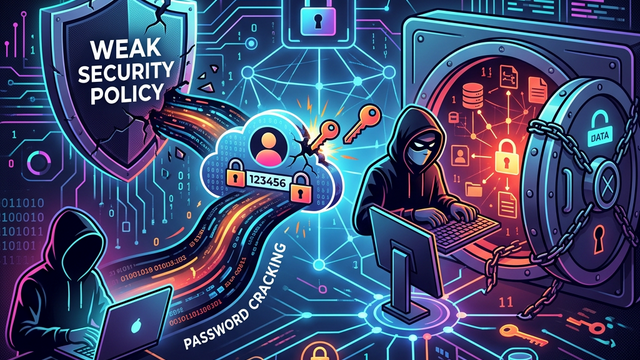
In the modern digital landscape, passwords remain the primary gatekeepers of sensitive corporate data and personal information. However, despite decades of security awareness, many organizations still struggle with a fundamental vulnerability: the weak password policy. A weak password policy is more than just a list of simple passwords; it is a systemic failure in how an organization authenticates users, manages credentials, and monitors for unauthorized access. For attackers, these policies are the path of least resistance, offering a high-probability entry point into even the most sophisticated networks.
Understanding Weak Password Policies
A password policy is a set of rules designed to enhance computer security by encouraging users to employ strong passwords and use them correctly. When these rules are too lax, non-existent, or poorly enforced, the policy is considered weak. Traditionally, security professionals focused solely on complexity-requiring symbols, numbers, and uppercase letters. However, modern cybersecurity standards, such as those provided by the National Institute of Standards and Technology (NIST), have shifted the focus toward length and the prevention of known-compromised credentials.
Common characteristics of a weak password policy include:
- Short Minimum Length: Allowing passwords shorter than 12 characters.
- Lack of Complexity Requirements: Not requiring a mix of character types (though length is now considered more important than complexity).
- No Account Lockout Thresholds: Allowing an infinite number of failed login attempts, which facilitates brute-force attacks.
- Predictable Rotation Requirements: Forcing users to change passwords every 30-90 days, which often leads to "password incrementing" (e.g., Summer2023! becoming Summer2024!).
- Lack of MFA (Multi-Factor Authentication): Relying solely on a password for identity verification.
- No Contextual Validation: Allowing passwords that contain the company name, the username, or common words like "password" or "123456".
To proactively monitor your organization's external attack surface and catch exposures such as login portals with weak configurations before attackers do, try Jsmon.
How Attackers Exploit Weak Password Policies
Attackers utilize various automated tools and methodologies to exploit weak authentication frameworks. Understanding these methods is the first step in defending against them.
1. Brute Force Attacks
In a classic brute-force attack, an attacker uses software to try every possible combination of characters until the correct password is found. While this is computationally expensive for long passwords, weak policies that allow short passwords (e.g., 6 characters) make this trivial. For instance, a 6-character password using only lowercase letters has only 308 million combinations, which a modern GPU can crack in seconds.
2. Dictionary Attacks
Instead of trying every character combination, a dictionary attack uses a pre-defined list of common words, phrases, and previously leaked passwords. Attackers often use the "RockYou.txt" wordlist, which contains tens of millions of passwords from real-world breaches. If your policy allows users to choose common words, they will likely fall victim to this method.
3. Password Spraying
Password spraying is a sophisticated technique designed to bypass account lockout policies. Instead of trying many passwords against one user, the attacker tries one very common password (like Password123!) against hundreds or thousands of different usernames. Because they only try one attempt per user every few hours, they stay below the radar of most automated lockout mechanisms.
4. Credential Stuffing
This exploit relies on the fact that users often reuse passwords across multiple services. Attackers take databases of leaked usernames and passwords from one breach (e.g., a social media site) and "stuff" them into the login portals of other services (e.g., corporate VPNs or banking portals). If the target organization doesn't enforce unique, complex passwords or MFA, the attacker gains easy access.
Technical Examples and Payload Demonstrations
To understand the gravity of these vulnerabilities, let's look at how an attacker might execute these exploits using common tools.
Example 1: Basic Dictionary Attack with Python
A simple Python script can be used to automate a dictionary attack against a web form that lacks rate limiting. This script iterates through a wordlist and sends POST requests to the target authentication endpoint.
import requests

target_url = "https://example-target.com/login"
username = "admin"
password_list = "passwords.txt"

def attempt_login(password):
    data = {"user": username, "pass": password}
    response = requests.post(target_url, data=data)
    if "Login Failed" not in response.text:
        print(f"[+] Success! Password found: {password}")
        return True
    return False

with open(password_list, "r") as file:
    for line in file:
        pwd = line.strip()
        if attempt_login(pwd):
            break
Example 2: Password Spraying with Hydra
THC-Hydra is a powerful tool used by penetration testers to perform rapid dictionary attacks and password spraying. The following command demonstrates a password spray against an SSH service, testing the password Welcome2024! against a list of known usernames.
hydra -L users.txt -p Welcome2024! 192.168.1.50 ssh
In this scenario, if the organization's policy didn't prevent the use of seasonal passwords, the attacker might successfully compromise multiple accounts in one sweep without triggering a single account lockout.
Example 3: Analyzing Password Complexity with Regex
From a defensive standpoint, developers can use Regular Expressions (Regex) to enforce stronger policies. A weak policy might use a simple regex, while a strong one ensures multiple character classes and length.
Weak Policy Regex (Minimum 6 chars, any type):
^.{6,}$
Stronger Policy Regex (Min 12 chars, 1 upper, 1 lower, 1 digit, 1 special):
^(?=.*[a-z])(?=.*[A-Z])(?=.*\d)(?=.*[@$!%*?&])[A-Za-z\d@$!%*?&]{12,}$
The Impact of a Policy Breach
The consequences of a successful exploit due to a weak password policy can be devastating. Once an attacker gains a foothold via a single compromised account, they can perform several malicious actions:
- Lateral Movement: Attackers use the initial account to explore the internal network, looking for higher-value targets like domain controllers or database servers.
- Data Exfiltration: Access to an employee's email or cloud storage allows attackers to steal intellectual property, customer data, and financial records.
- Ransomware Deployment: Many ransomware attacks begin with a simple credential compromise on a VPN or RDP (Remote Desktop Protocol) instance.
- Reputational Damage: News of a breach caused by "admin/admin" or "Password123" can destroy customer trust and lead to regulatory fines under frameworks like GDPR or CCPA.
Modern Best Practices: Beyond the Basics
To defend against modern threats, organizations must move beyond the "change your password every 90 days" mentality. Current industry standards, specifically NIST 800-63B, suggest the following:
1. Prioritize Length Over Complexity
A 16-character passphrase like correct-horse-battery-staple is significantly harder to crack than an 8-character complex password like P@ssw0rd!. Length exponentially increases the time required for brute-force attacks.
2. Check Against Known Breaches
Integrate your sign-up and password-change forms with APIs like "Have I Been Pwned". This prevents users from choosing passwords that are already known to be in attacker wordlists.
3. Implement Multi-Factor Authentication (MFA)
MFA is the single most effective defense against password-based attacks. Even if an attacker successfully guesses a password, they cannot gain access without the second factor (e.g., a TOTP code or hardware key).
4. Use Adaptive Authentication
Monitor for suspicious login patterns. If a user normally logs in from New York but suddenly attempts a login from a different continent, the system should trigger additional verification steps or block the attempt entirely.
5. Monitor Your External Surface
Often, weak password policies exist on "Shadow IT"-servers or applications spun up by departments without the knowledge of the central IT team. These forgotten portals often have default credentials or no lockout policies. Using a platform like Jsmon helps you discover these hidden assets before they become a liability.
Conclusion
A weak password policy is a silent invitation to cybercriminals. While it may seem like a minor administrative detail, it is frequently the root cause of high-profile data breaches. By shifting toward modern standards-emphasizing length, banning compromised passwords, and mandating MFA-organizations can significantly harden their defenses. Security is not a one-time setup but a continuous process of monitoring and improvement.
To proactively monitor your organization's external attack surface and catch exposures such as misconfigured login portals or weak authentication endpoints before attackers do, try Jsmon.