What is Unrestricted File Upload? Ways to Exploit, Examples and Impact
Explore unrestricted file upload vulnerabilities. Learn how attackers use web shells and XSS to compromise servers and how to implement robust security.
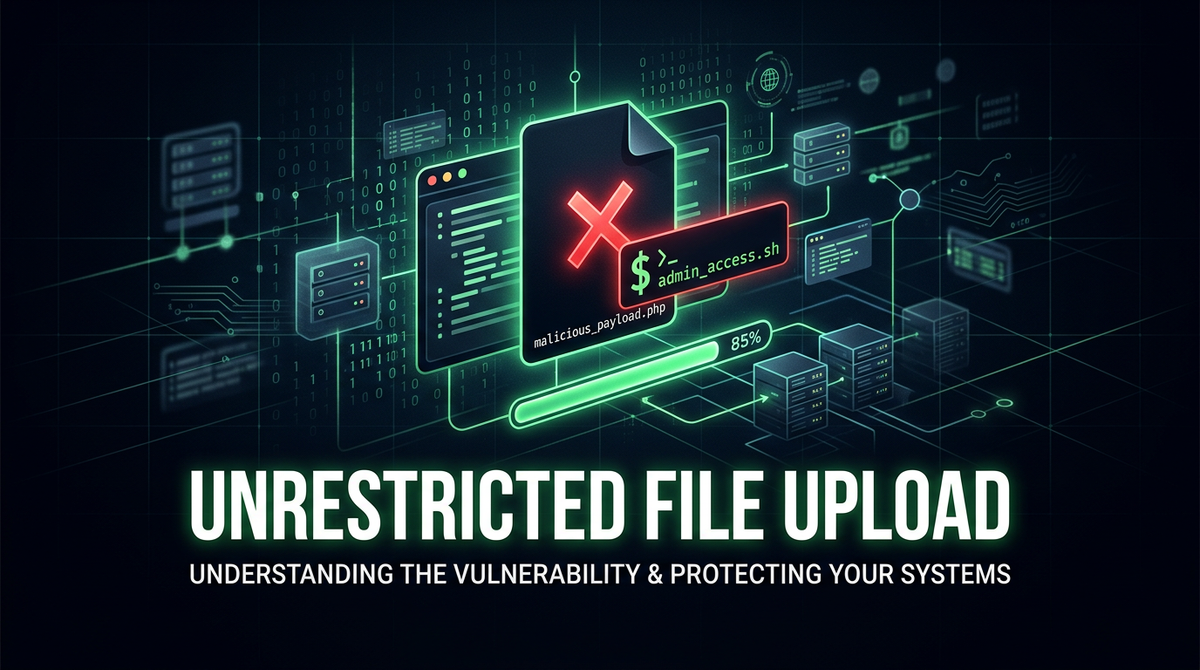
File upload functionality is a staple of modern web applications, allowing users to share profile pictures, submit resumes, or upload documents for collaboration. However, when a web server allows users to upload files without sufficient validation, it opens a dangerous door known as an Unrestricted File Upload vulnerability. This flaw is one of the most critical security risks because it often leads directly to full system compromise, data breaches, and persistent malware hosting.
In this guide, we will explore the technical nuances of how these vulnerabilities work, the creative ways attackers bypass security filters, and the steps you can take to harden your infrastructure. Understanding these risks is essential for any developer or security professional tasked with maintaining a secure Jsmon monitored perimeter.
Understanding Unrestricted File Upload (UFU)
An Unrestricted File Upload vulnerability occurs when an application fails to properly validate the type, size, contents, or name of a file uploaded by a user. While it may seem like a simple oversight, the implications are vast. If an attacker can upload a file that the server then executes—such as a PHP, ASPX, or JSP script—they can gain a foot-hold inside the internal network.
This vulnerability usually arises from a misplaced trust in user input. Developers often assume that users will only upload the files the UI asks for (like a .jpg). However, an attacker can bypass the browser's interface entirely using tools like Burp Suite or cURL to send arbitrary files directly to the server's backend processing logic.
The Mechanics: How File Uploads Work
When you upload a file, your browser typically sends a POST request with a Content-Type header set to multipart/form-data. The body of the request contains the file data, the filename, and a sub-header defining the MIME type of the specific file.
Example of a standard upload request:
POST /upload HTTP/1.1
Host: example.com
Content-Type: multipart/form-data; boundary=---------------------------12345

-----------------------------12345
Content-Disposition: form-data; name="avatar"; filename="profile.png"
Content-Type: image/png

[Binary Data Here]
-----------------------------12345--
The server receives this data and must decide where to store it and how to handle it. If the server is configured to execute files in the upload directory, and it doesn't check if profile.png is actually a script disguised as an image, the security of the entire host is at risk.
Common Exploitation Techniques
Attackers use several methods to exploit file upload features, depending on the server's configuration and the language the application is written in.
1. Remote Code Execution (RCE) via Web Shells
This is the "holy grail" for attackers. By uploading a small script, known as a web shell, an attacker can execute OS commands via the web browser. If the application is running on PHP, an attacker might upload a file named shell.php containing:
<?php
if(isset($_GET['cmd'])) {
    system($_GET['cmd']);
}
?>
Once uploaded, the attacker navigates to https://example.com/uploads/shell.php?cmd=whoami. The server executes the PHP code and returns the username of the web server process. From here, the attacker can move laterally through the network, steal database credentials, or encrypt files for ransom.
2. Stored Cross-Site Scripting (XSS)
Even if the server doesn't execute the file as a script, it might still be vulnerable to XSS. If an attacker uploads an .html file or an .svg file containing malicious JavaScript, any user who views that file in their browser will execute the script in the context of the application's domain.
Example of a malicious SVG payload:
<svg xmlns="http://www.w3.org/2000/svg">
  <script>alert('XSS via SVG Upload');</script>
</svg>
When a victim clicks the link to view this "image," the script could steal their session cookies or redirect them to a phishing site.
3. Path Traversal and File Overwriting
If the application uses the user-provided filename to save the file on the disk without sanitization, an attacker can use path traversal sequences (../) to save the file in a sensitive location.
For instance, if the upload path is /var/www/uploads/, an attacker might set the filename to ../../etc/passwd or ../index.php. If the web server has write permissions to those directories, the attacker could overwrite critical system files or the website's homepage.
4. Server-Side Request Forgery (SSRF) and Metadata Exploitation
Many modern applications process uploaded files to extract metadata (like EXIF data from photos) or to resize images. Vulnerable processing libraries (like ImageMagick) have historically been susceptible to exploits where a specially crafted image triggers an SSRF or even RCE (e.g., ImageTragick).
An attacker could upload an image that, when processed, forces the server to make a request to an internal metadata service (like http://169.254.169.254 on AWS) to leak sensitive cloud credentials.
5. Denial of Service (DoS) Attacks
Attackers can also use file uploads to exhaust server resources. This is often done via:
- Large Files: Uploading multi-gigabyte files to fill up the server's disk space.
- Pixel Floods: Uploading a small image file that claims to have massive dimensions (e.g., 50,000x50,000 pixels). When the server attempts to process or resize the image, it exhausts its RAM and crashes.
- Zip Bombs: Uploading a highly compressed archive that expands to hundreds of terabytes when decompressed by the server.
Bypassing Security Filters
Developers often implement "quick fixes" to prevent these attacks, but seasoned attackers know how to bypass them. A robust security posture monitored by Jsmon requires understanding these bypasses.
Client-Side Bypass
Validating file types in JavaScript on the frontend is purely for user experience; it is not a security feature. An attacker can simply disable JavaScript in their browser or use a proxy like Burp Suite to change the file extension after the client-side check has passed but before the request hits the server.
Extension Blacklist Bypass
Some developers maintain a list of "forbidden" extensions like .php or .exe. Attackers can bypass these by using less common but still executable extensions:
- PHP:
.php5,.phtml,.php.jpg(if the server is misconfigured to execute any file containing .php). - ASP.NET:
.ashx,.asmx,.config. - Case Sensitivity: Sometimes
FILE.PHpmight bypass a filter that only looks for lowercase.php.
Content-Type and Magic Byte Spoofing
If the server checks the Content-Type header, an attacker can simply change application/x-php to image/jpeg in the HTTP request.
More sophisticated servers check the "Magic Bytes" (the first few bytes of a file that identify its format). An attacker can bypass this by prepending the magic bytes of a valid image to their malicious script. For example, a PHP shell can be disguised as a GIF by starting the file with GIF89a;:
GIF89a;
<?php system($_GET['cmd']); ?>
The Business Impact of File Upload Vulnerabilities
The impact of an unrestricted file upload vulnerability is almost always "Critical."
- Full System Compromise: Once an attacker has an RCE shell, they can install backdoors, exfiltrate the entire database, and gain persistence on the network.
- Defacement: Overwriting the website's index page to display political or malicious messages, damaging the brand's reputation.
- Malware Distribution: Using your trusted domain to host and distribute malware to your users.
- Legal and Compliance Risks: Data breaches resulting from file uploads can lead to heavy fines under GDPR, CCPA, or HIPAA.
How to Prevent Unrestricted File Upload
Securing file uploads requires a multi-layered "Defense in Depth" approach. Relying on a single check is never enough.
- Whitelist Extensions: Never use a blacklist. Only allow specific, known-safe extensions (e.g.,
.jpg,.pdf,.png). - Rename Uploaded Files: Generate a random UUID or hash for every uploaded file and append the extension yourself. Do not use the user-provided filename on the disk.
- Validate File Content: Use a library to verify that the file content actually matches the extension. For images, re-encode the image to strip out malicious metadata or embedded scripts.
- Store Files Outside the Web Root: Uploaded files should be stored in a directory that is not accessible via a URL. Use a proxy script to serve the files if they must be viewed.
- Disable Execution Permissions: Configure the upload directory to prevent the execution of scripts. In Apache, this can be done via
.htaccessusingRemoveHandlerorOptions -ExecCGI. In Nginx, uselocation ^~ /uploads/ { internal; }or ensure no fastcgi pass exists for that path. - Use a Content Delivery Network (CDN): Serving user-uploaded content from a separate domain (e.g.,
user-content.com) or a CDN helps mitigate XSS and protects your primary session cookies. - Limit File Size: Enforce strict minimum and maximum file size limits at the web server level (e.g.,
client_max_body_sizein Nginx).
Conclusion
Unrestricted file upload vulnerabilities represent a significant threat to web application security. By allowing users to place files directly onto your server, you are essentially trusting them with the keys to your digital home. By implementing strict whitelisting, file renaming, and execution prevention, you can significantly reduce your risk profile.
To proactively monitor your organization's external attack surface and catch exposures before attackers do, try Jsmon.