What is Time-Based Blind SQL Injection? Ways to Exploit, Examples and Impact
Master Time-Based Blind SQL Injection techniques, examples, and prevention strategies in this comprehensive technical guide for security pros.
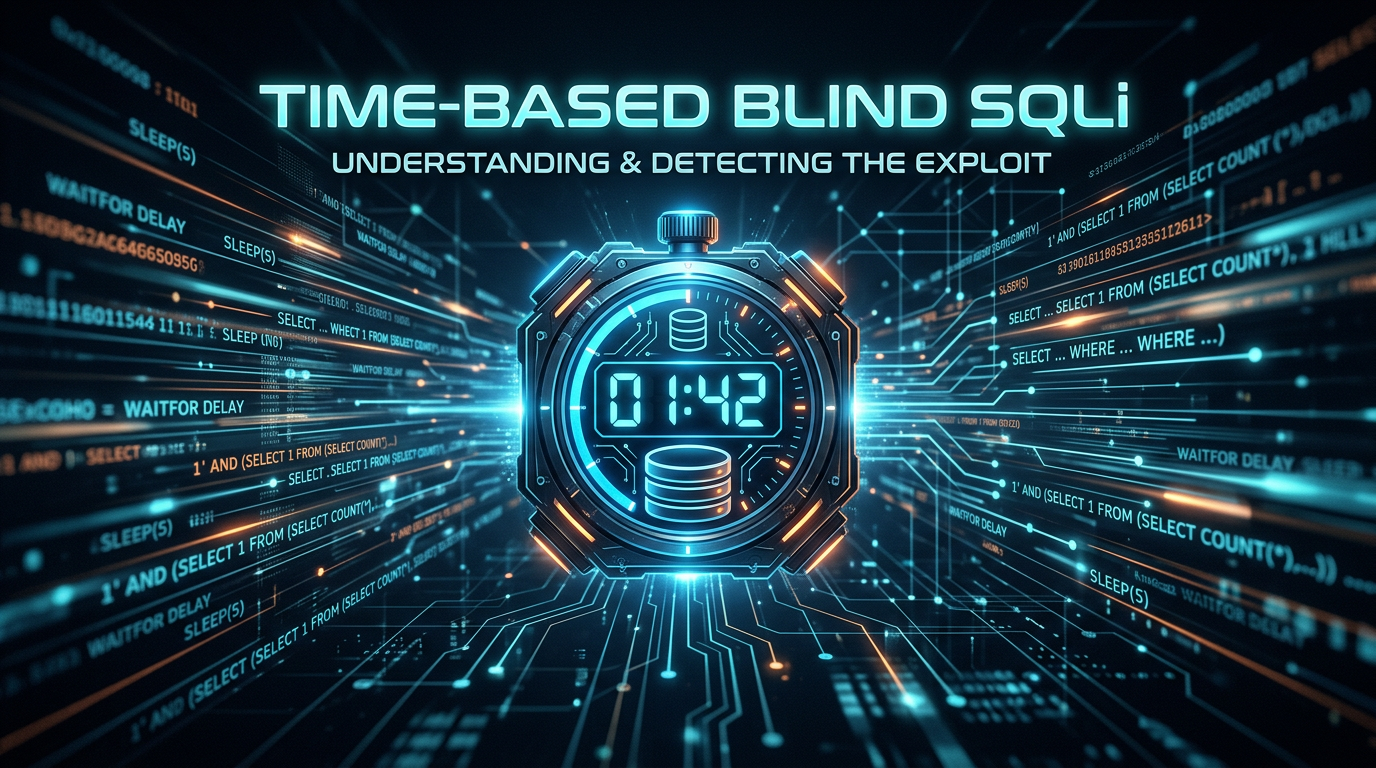
SQL Injection remains one of the most persistent and damaging vulnerabilities in the web security landscape. While traditional SQL injection allows an attacker to see data directly in the application's response, Time-Based Blind SQL Injection is a more subtle, "quiet" technique used when the server provides no visible feedback. By forcing the database to wait for a specific amount of time before responding, an attacker can infer sensitive information bit by bit, effectively turning the server's response time into a data exfiltration channel.
Understanding the Basics: What is Blind SQL Injection?
To understand Time-Based Blind SQL Injection, we must first define the broader category of Blind SQL Injection. In a standard SQL injection (SQLi), the application might display database errors or the results of a SELECT query directly on the page. For example, if you inject ' OR 1=1 --, the page might show all records in a table.
However, in many modern applications, developers suppress database errors and do not display query results directly. This is where "Blind" SQLi comes into play. There are two primary types:
- Boolean-Based Blind SQLi: The attacker asks the database a true/false question. If the answer is true, the page loads normally. If the answer is false, the page might show a "Not Found" error or a slightly different layout. By observing these changes, the attacker can deduce data.
- Time-Based Blind SQLi: This is used when the application's response is identical regardless of whether a query is true or false. In this scenario, the attacker instructs the database to pause (sleep) for a specific duration if a condition is met. If the server takes five seconds longer to respond, the attacker knows the condition was true.
How Time-Based Blind SQL Injection Works
The core logic of a time-based attack relies on conditional statements and time-delay functions. The attacker crafts a payload that says: "If the first letter of the administrator's password is 'A', wait for 10 seconds. Otherwise, respond immediately."
By measuring the time it takes for the HTTP response to arrive, the attacker confirms the truth of the statement. Because this process only extracts one bit of information at a time (True or False), it is significantly slower than other SQLi methods, but it is incredibly effective in environments where error messages and content changes are suppressed.
Essential Time-Delay Functions by Database
Different Database Management Systems (DBMS) use different functions to induce a delay. Identifying the underlying database is often the first step in a successful exploit.
- MySQL / MariaDB: Uses the
SLEEP(seconds)orBENCHMARK()functions. - PostgreSQL: Uses the
pg_sleep(seconds)function. - Microsoft SQL Server (MSSQL): Uses the
WAITFOR DELAY 'hours:minutes:seconds'command. - Oracle: Uses
DBMS_LOCK.SLEEP(seconds)(though this often requires specific permissions).
Technical Examples and Payloads
Let's look at how these attacks manifest in the real world. Imagine a web application that fetches product details via a URL parameter: https://example.com/products.php?id=123.
1. Testing for Vulnerability
The first step is to see if the database responds to time commands. An attacker might try the following payload in the id parameter:
123 AND (SELECT 1 FROM (SELECT(SLEEP(5)))a)
In a URL-encoded format, this would look like:?id=123%20AND%20(SELECT%201%20FROM%20(SELECT(SLEEP(5)))a)
If the page takes exactly 5 seconds longer to load than usual, the application is likely vulnerable to Time-Based Blind SQL Injection.
2. Identifying the Database Version
Once the vulnerability is confirmed, the attacker can start asking specific questions. To check if the database is MySQL version 8.x, they might use:
123 AND IF(SUBSTRING(VERSION(),1,1)='8', SLEEP(5), 0)
Here, SUBSTRING(VERSION(),1,1) grabs the first character of the version string. If it equals '8', the SLEEP(5) function executes. If the response is delayed, the attacker knows the version starts with 8.
3. Extracting Data: The Bit-by-Bit Process
To extract a username or password, the attacker uses the ASCII() and SUBSTRING() functions. Computers represent characters as numbers (ASCII). For instance, 'A' is 65, 'B' is 66, and so on.
To find the first letter of the database user, the attacker might run a series of requests:
?id=123 AND IF(ASCII(SUBSTRING(USER(),1,1))>100, SLEEP(5), 0)(Wait? Yes/No)?id=123 AND IF(ASCII(SUBSTRING(USER(),1,1))>110, SLEEP(5), 0)(Wait? Yes/No)
By using a binary search algorithm (splitting the range of possible ASCII values in half each time), the attacker can quickly identify each character of any string in the database.
Advanced Exploitation: Bypassing Filters
Modern Web Application Firewalls (WAFs) often look for keywords like SLEEP or WAITFOR. Attackers use various obfuscation techniques to bypass these signatures.
Using BENCHMARK() in MySQL
If SLEEP() is blocked, an attacker might use BENCHMARK(), which executes an expression millions of times to consume CPU cycles and create a delay:
123 AND IF(1=1, BENCHMARK(5000000, MD5('test')), 0)
Mathematical Obfuscation
Instead of using a clear number like 5, attackers might use mathematical expressions:
123 AND IF(1=1, SLEEP(6*1-1), 0)
The Real-World Impact of Time-Based SQLi
While time-based attacks are slow, they are no less dangerous than their faster counterparts. The impact includes:
- Full Data Exfiltration: Attackers can dump entire databases, including customer PII (Personally Identifiable Information), credit card numbers, and credentials.
- Authentication Bypass: By injecting into login fields, attackers can bypass password checks by forcing a delay only when the "admin" user exists.
- Infrastructure Reconnaissance: Attackers can use database functions to read local files or, in some configurations (like MSSQL with
xp_cmdshell), execute operating system commands. - Resource Exhaustion: If an attacker sends thousands of requests that each trigger a 30-second sleep, they can effectively perform a Denial of Service (DoS) attack, tying up all available database connections.
How to Prevent Time-Based Blind SQL Injection
Preventing this vulnerability requires a defense-in-depth approach. The most effective methods include:
1. Use Prepared Statements (Parameterized Queries)
This is the gold standard for SQLi prevention. Instead of concatenating user input into a query string, you use placeholders. The database treats the input strictly as data, never as executable code.
Vulnerable Code (PHP):
$id = $_GET['id'];
$query = "SELECT name FROM products WHERE id = $id";
$result = $conn->query($query);
Secure Code (PHP with PDO):
$id = $_GET['id'];
$stmt = $pdo->prepare('SELECT name FROM products WHERE id = :id');
$stmt->execute(['id' => $id]);
$user = $stmt->fetch();
2. Implement Input Validation and Sanitization
Never trust user input. If you expect a product ID to be a number, ensure it is an integer before passing it to any database logic. Use allow-lists for sorting parameters or table names that cannot be parameterized.
3. Principle of Least Privilege
Ensure the database user account used by the web application has the minimum permissions necessary. For example, a web user should not have permission to execute DBMS_LOCK.SLEEP or access system-level tables unless absolutely required.
4. Use a Web Application Firewall (WAF)
While not a complete fix, a WAF can help detect and block common SQLi patterns and time-delay payloads, providing an extra layer of security while you patch the underlying code.
Conclusion
Time-Based Blind SQL Injection is a sophisticated attack that proves silence is not security. Even when an application doesn't return errors or data, the subtle variations in response timing can reveal everything an attacker needs to know. By understanding how these delays are triggered and the logic used to extract data, developers and security professionals can better defend their infrastructure against these stealthy threats.
To proactively monitor your organization's external attack surface and catch exposures like potential injection points before attackers do, try Jsmon.