What is Server-Side Request Smuggling? Ways to Exploit, Examples and Impact
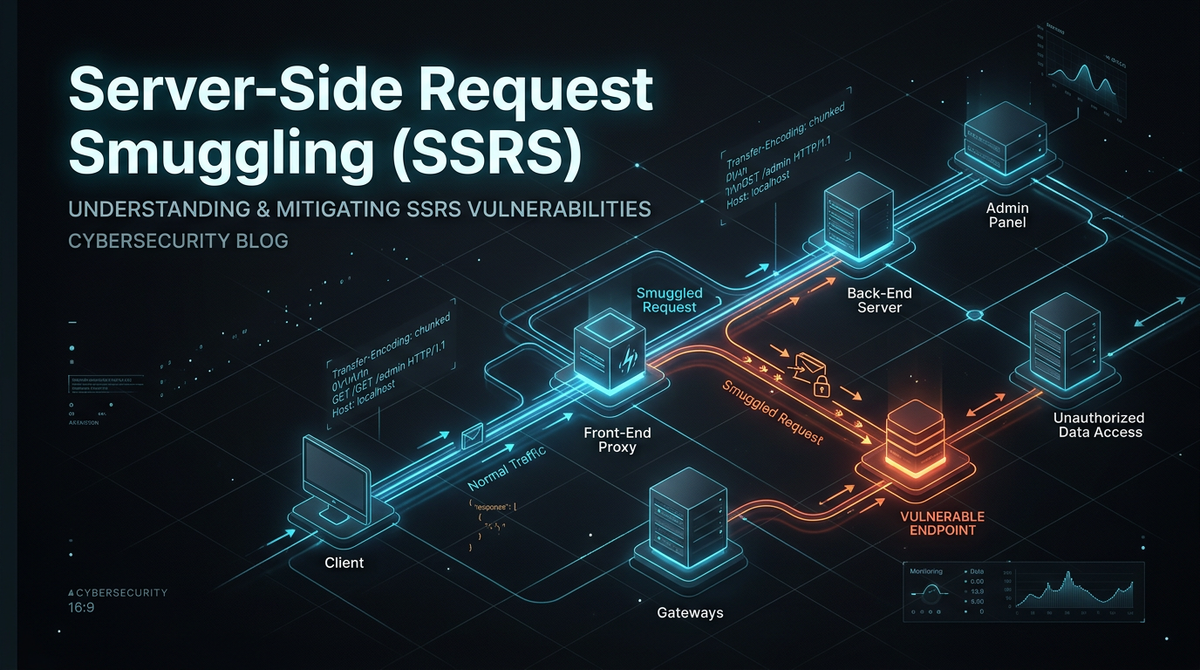
In the modern landscape of web architecture, applications are rarely standalone entities. They typically sit behind a chain of servers, including load balancers, reverse proxies, and content delivery networks (CDNs). While this multi-tiered approach improves performance and scalability, it introduces a dangerous class of vulnerability known as Server-Side Request Smuggling (SSRS). This flaw exploits discrepancies in how different servers interpret HTTP request boundaries, allowing an attacker to "smuggle" a hidden request inside a legitimate one.
Understanding Server-Side Request Smuggling is critical for any security professional because it bypasses frontend security controls, enables unauthorized access to sensitive data, and can even lead to complete session hijacking. In this guide, we will break down the mechanics of request smuggling, explore the technical differences between CL.TE and TE.CL attacks, and provide practical examples of how these vulnerabilities are exploited in the wild.
The Architecture of a Request Smuggling Attack
To grasp how smuggling works, we must first look at how modern web environments handle HTTP requests. When a user sends a request to a website, it usually hits a frontend server (like Nginx, HAProxy, or an AWS ELB) first. This frontend server then forwards the request to one or more backend servers.
To maximize efficiency, these servers often use HTTP keep-alive connections. Instead of opening a new TCP connection for every single request, they reuse a single persistent connection to send multiple requests in a stream. This is where the danger lies. For the backend server to know where one request ends and the next begins, both the frontend and backend must agree on the boundaries of each request.
If the frontend and backend disagree on the size of a request, an attacker can craft a payload that the frontend sees as one request, but the backend sees as two separate requests. The second "smuggled" request stays in the backend server's buffer and gets prepended to the next legitimate user's request.
The Role of HTTP Headers: CL and TE
Request smuggling relies on two specific HTTP headers that define the length of a request body:
- Content-Length (CL): This header specifies the size of the request body in bytes. For example,
Content-Length: 11means the body contains exactly 11 characters. - Transfer-Encoding (TE): This header specifies that the request body uses chunked encoding. In chunked encoding, the body is sent in blocks, each preceded by its size in hexadecimal, followed by a final terminating chunk of
0.
According to the HTTP specification (RFC 7230), if a request contains both headers, the Transfer-Encoding header should take precedence. However, many legacy servers or custom implementations do not follow this rule, or they can be manipulated into ignoring one of the headers. This discrepancy creates the opportunity for a desynchronization attack.
Types of Request Smuggling Vulnerabilities
There are three primary categories of request smuggling, named after which header the frontend and backend servers prioritize.
1. CL.TE: Frontend uses Content-Length, Backend uses Transfer-Encoding
In a CL.TE vulnerability, the frontend server looks at the Content-Length header to determine the request size, while the backend server looks at the Transfer-Encoding header.
Example Payload:
POST / HTTP/1.1
Host: vulnerable-site.com
Content-Length: 13
Transfer-Encoding: chunked

0

SMUGGLED
How it works:
- The frontend sees
Content-Length: 13. It counts 13 bytes (including the0and the wordSMUGGLED) and forwards the entire request to the backend. - The backend sees
Transfer-Encoding: chunked. It processes the0as the end of the first chunked request. - The backend considers the first request finished and leaves the remaining string
SMUGGLEDin its internal buffer. - When the next legitimate user sends a request, the backend attaches
SMUGGLEDto the start of that user's request, likely causing an error or unintended behavior.
2. TE.CL: Frontend uses Transfer-Encoding, Backend uses Content-Length
In this scenario, the frontend server supports chunked encoding, but the backend server only looks at the Content-Length header (or is configured to ignore TE).
Example Payload:
POST / HTTP/1.1
Host: vulnerable-site.com
Content-Length: 3
Transfer-Encoding: chunked

8
SMUGGLED
0
How it works:
- The frontend sees
Transfer-Encoding: chunked. It processes the chunk of size8(SMUGGLED), then the terminating0, and forwards everything to the backend. - The backend sees
Content-Length: 3. It only reads the first 3 bytes (the8and the following CRLF). - The backend treats the rest of the data (
SMUGGLED\n0) as the start of the next request in the pipeline.
3. TE.TE: Both servers support Transfer-Encoding
In a TE.TE attack, both servers support chunked encoding, but an attacker can obfuscate the Transfer-Encoding header so that one of the servers fails to process it. Common obfuscation techniques include:
Transfer-Encoding: xchunkedTransfer-Encoding : chunked(extra space)Transfer-Encoding: chunked, identity
If the frontend processes the obfuscated header but the backend does not (or vice versa), the attack effectively reverts to a CL.TE or TE.CL scenario.
Real-World Exploitation Scenarios
Request smuggling is not just a theoretical exercise; it has devastating real-world impacts. Here are common ways attackers leverage this desynchronization.
Bypassing Frontend Security Controls
Many organizations use a frontend proxy to enforce security rules, such as blocking access to /admin or /internal-api. Because the frontend only sees the "outer" request, the smuggled "inner" request can bypass these filters entirely.
Payload:
POST / HTTP/1.1
Host: vulnerable-site.com
Content-Length: 60
Transfer-Encoding: chunked

0

GET /admin HTTP/1.1
Host: localhost
Foo: x
The frontend sees a POST to /, which is allowed. The backend, however, sees a smuggled GET request to /admin coming from the local buffer, often granting the attacker administrative access.
Request Tunneling and Data Exfiltration
An attacker can smuggle a partial request that "captures" the next user's request data. If the application has a feature that reflects user input (like a search bar or a profile update page), the attacker can prepend a smuggled request that causes the next user's entire HTTP request—including their session cookies—to be saved into the attacker's account or displayed on a public page.
Web Cache Poisoning
If the application uses a frontend cache, an attacker can use request smuggling to cause the cache to store a malicious response. For example, the attacker could smuggle a request for a JavaScript file that redirects to a malicious server. If the frontend cache associates this malicious response with a legitimate URL (like /scripts/main.js), every user who visits the site will execute the attacker's script.
How to Detect Request Smuggling
Detecting request smuggling manually is difficult because it relies on timing and the state of the backend connection pool. However, there are several indicators:
- Time Delays: Sending a CL.TE payload where the
Content-Lengthis slightly larger than the actual body may cause the frontend to wait for more data, resulting in a timeout. - Differential Responses: Sending a sequence of requests where the second request's response changes based on the content of the first smuggled request.
- Automated Scanning: Tools like Jsmon can help identify exposed infrastructure and misconfigured proxies that might be susceptible to these types of desynchronization issues.
Mitigation and Prevention
The most effective way to prevent Server-Side Request Smuggling is to address the underlying architectural discrepancies. Here are the industry best practices:
- Use HTTP/2 End-to-End: HTTP/2 uses a binary framing mechanism that eliminates the ambiguity of request boundaries. If both the frontend and backend communicate via HTTP/2, smuggling becomes virtually impossible.
- Disable Connection Reuse: While this impacts performance, disabling HTTP keep-alive on the backend prevents the desynchronization of the request stream.
- Strict Header Validation: Configure your frontend and backend to use the same web server software (e.g., both using the same version of Nginx) so they interpret headers identically.
- Reject Ambiguous Requests: Configure proxies to reject any request that contains both a
Content-Lengthand aTransfer-Encodingheader. - WAF Implementation: Modern Web Application Firewalls have built-in signatures to detect common request smuggling patterns and obfuscated headers.
Conclusion
Server-Side Request Smuggling is a high-impact vulnerability that highlights the complexity of modern web stacks. By exploiting the subtle ways that servers parse HTTP headers, attackers can jump between user sessions, bypass critical security boundaries, and compromise internal systems. As organizations move toward microservices and complex proxy chains, understanding and mitigating these desynchronization risks is more important than ever.
To proactively monitor your organization's external attack surface and catch exposures before attackers do, try Jsmon. By keeping a constant eye on your infrastructure changes, Jsmon ensures you stay ahead of misconfigurations that lead to vulnerabilities like request smuggling.