What is Second-Order SQL Injection? Ways to Exploit, Examples and Impact
Learn how Second-Order SQL Injection works, see technical code examples, and discover best practices to prevent this persistent database vulnerability.
SQL Injection (SQLi) has remained a top threat in the web security landscape for decades. While most developers are familiar with the standard "first-order" SQL injection—where an attacker provides malicious input that is immediately executed by the database—there is a more subtle and dangerous variant known as Second-Order SQL Injection. This vulnerability is particularly treacherous because it bypasses traditional input validation filters that only look for immediate threats. In this post, we will dive deep into the mechanics of Second-Order SQLi, explore technical examples, and discuss how to defend your infrastructure against this persistent threat.
What is Second-Order SQL Injection?
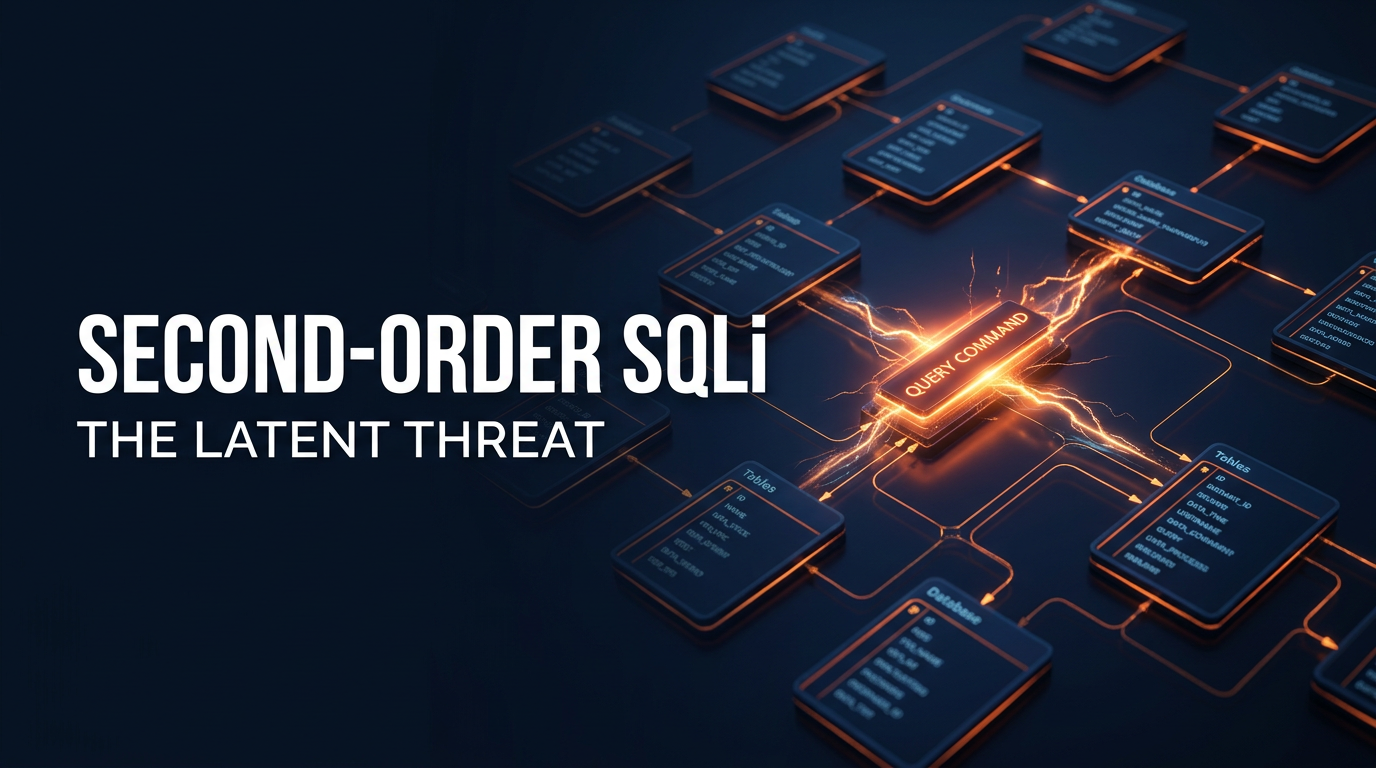
Second-Order SQL Injection occurs when an application accepts malicious input from a user, stores it in a database, and then later retrieves and uses that data in a different SQL query in an unsafe manner. Unlike first-order SQLi, the attack does not happen the moment the payload is submitted. Instead, the payload sits dormant in the database until a subsequent administrative or user-triggered action pulls that data into a new query context where it is executed.
This vulnerability is often referred to as "Stored SQL Injection" because the malicious payload is persistent. The core issue lies in a misplaced sense of trust: developers often assume that data already residing in their database is "clean" or "safe." Because the data was likely sanitized or parameterized when it was first inserted, the application fails to treat it as untrusted input when it is retrieved for later use. This gap in the trust boundary is exactly what attackers exploit.
How Second-Order SQL Injection Differs from Classic SQLi
To understand the gravity of Second-Order SQLi, we must compare it to its first-order counterpart. In a classic SQL injection attack, the interaction is direct. For example, a user enters a payload into a login form, and the application immediately concatenates that string into a SELECT statement. If the application doesn't sanitize the input, the database executes the malicious command instantly.
In contrast, Second-Order SQLi is a two-step process:
- The Injection Phase: The attacker submits a payload that is designed to be malicious when executed later, but looks like a legitimate (if slightly odd) string during the initial storage. The application might even use prepared statements to save this data, making it appear that the system is secure.
- The Execution Phase: At a later time, perhaps when a user views their profile or an admin generates a report, the application fetches the stored payload and places it directly into a new SQL query string. At this point, the malicious payload is triggered.
Because the payload is stored, it can affect different parts of the application or even different users entirely, making it much harder to track and remediate using standard automated scanners.
The Mechanics of a Second-Order SQLi Attack
Let's break down the technical workflow of a Second-Order SQLi attack using a common web application scenario: a user registration and password change system.
Step 1: The Malicious Input
An attacker signs up for a new account. When asked for a username, they provide a string that contains SQL syntax. For example:
admin'--
The application receives this input. During the registration process, the developer uses a prepared statement to insert the user into the database:
INSERT INTO users (username, password) VALUES (?, ?);
Because a prepared statement is used, the literal string admin'-- is safely stored in the username column. No injection occurs at this stage. The attacker now has a valid account with a very strange username.
Step 2: The Latent Payload
The payload now lives in the users table. To any observer, it just looks like a username. The database engine does not see it as code; it sees it as data.
Step 3: The Triggering Action
Later, the attacker decides to change their password. The application has a change_password.php script that performs the following logic:
- Retrieve the current user's username from the session (which was pulled from the database when they logged in).
- Update the password for that username.
Here is where the developer makes a fatal mistake by trusting the data coming from the database:
// Fetching the username from the database/session
$username = $_SESSION['username']; // This is "admin'--"
$new_password = $_POST['new_password'];

// Unsafe query construction
$query = "UPDATE users SET password = '$new_password' WHERE username = '$username'";
$db->execute($query);
Step 4: Execution
When the variables are concatenated into the string, the resulting SQL query sent to the database looks like this:
UPDATE users SET password = 'hacked_password' WHERE username = 'admin'--'
In SQL, -- is a comment identifier. Everything after the -- is ignored. The database executes the following effective command:
UPDATE users SET password = 'hacked_password' WHERE username = 'admin'
Instead of changing the attacker's own password, the application has just changed the password for the real admin user. The attacker can now log in as the administrator.
Technical Examples and Payloads
Second-order vulnerabilities can manifest in various ways depending on how the stored data is used. Below are a few common scenarios.
Example 1: Profile Information and Administrative Dashboards
Imagine a social media platform where users can set a "Bio." An attacker sets their bio to:
', (SELECT GROUP_CONCAT(user, ':', password) FROM users), '1')--
If an administrator views a list of all user bios in a reporting tool that uses an unsafe INSERT into a temporary audit table, the attacker's bio could trigger an injection that leaks the entire user database into the audit log or the admin's view.
Example 2: Order Tracking and Concatenation
In an e-commerce system, a user might provide a "Shipping Note." If that note is later used in a query to calculate shipping costs or update order status without proper parameterization, the payload could be used to perform Blind SQL Injection.
Payload: 1' AND (SELECT 1 FROM (SELECT(SLEEP(5)))a)--
If the application takes 5 seconds longer to load the order history page, the attacker confirms that the database is vulnerable to time-based second-order injection.
Impact of Second-Order SQL Injection
The impact of Second-Order SQLi is identical to first-order SQLi but often carries a higher risk of being overlooked during development. The consequences include:
- Account Takeover: As shown in the password change example, attackers can modify the credentials of other users, including administrators.
- Data Exfiltration: Attackers can extract sensitive information from the database, such as personal identifiable information (PII), credit card details, or intellectual property.
- Data Loss or Corruption: Using
DELETEorUPDATEcommands, an attacker can destroy records or manipulate financial data. - Full System Compromise: In some configurations, attackers can use SQL commands (like
xp_cmdshellin SQL Server) to execute operating system commands, leading to a total server takeover.
Detection and Identification
Detecting Second-Order SQL Injection is notoriously difficult for automated tools. Most DAST (Dynamic Application Security Testing) scanners work by sending a payload and looking for an immediate response (like an error or a time delay). Since Second-Order SQLi requires a two-step interaction, these scanners often miss the vulnerability.
To identify these flaws, security professionals use the following methods:
- Manual Code Review: This is the most effective method. Reviewers look for instances where data retrieved from a database is used in a subsequent query without being parameterized.
- Traceability Analysis: Mapping out how data flows through the application. If data moves from
Input -> DB -> Query, it must be treated as untrusted at every stage. - Comprehensive Fuzzing: Testing sequences of actions. For example, updating a profile with a payload and then visiting every other page in the application to see if that payload triggers a change in behavior.
Prevention and Mitigation Strategies
The solution to Second-Order SQL Injection is simple in theory but requires discipline in practice: Never trust data, even if it comes from your own database.
1. Use Prepared Statements (Parameterized Queries)
This is the primary defense against all forms of SQL injection. You must use prepared statements not just when you first save data, but also when you retrieve it and use it in another query.
Incorrect (Vulnerable):
$user_data = $db->query("SELECT username FROM users WHERE id = 10");
$username = $user_data['username'];
// DANGER: Concatenating stored data
$db->execute("UPDATE logs SET last_seen = NOW() WHERE user = '$username'");
Correct (Secure):
$user_data = $db->query("SELECT username FROM users WHERE id = 10");
$username = $user_data['username'];
// SAFE: Using a prepared statement for the second query
$stmt = $db->prepare("UPDATE logs SET last_seen = NOW() WHERE user = ?");
$stmt->execute([$username]);
2. Input Validation and Sanitization
While not a replacement for prepared statements, validating input at the point of entry adds a layer of defense-in-depth. If a username should only contain alphanumeric characters, enforce that rule. This prevents the initial injection of SQL-specific characters like single quotes (') and comments (--).
3. Least Privilege Principle
Ensure that the database user used by the web application has the minimum permissions necessary. For instance, the user account responsible for updating user profiles should not have permission to drop tables or access system configuration files.
4. Consistent Use of ORMs
Modern Object-Relational Mapping (ORM) frameworks like Eloquent (Laravel), Hibernate (Java), or Entity Framework (ASP.NET) typically use parameterized queries by default. However, be careful with "raw query" functions within these ORMs, as they bypass the built-in protections.
Conclusion
Second-Order SQL Injection serves as a stark reminder that security is not a one-time check but a continuous process. The assumption that data is "safe" once it resides in your database is a dangerous fallacy that has led to countless breaches. By maintaining a strict trust boundary and ensuring that every single SQL query—regardless of where its parameters originate—is properly parameterized, developers can effectively neutralize this threat.
Understanding the lifecycle of a second-order attack is crucial for any developer or security professional. As applications grow in complexity, the paths that data takes become harder to visualize, making the consistent application of security best practices more important than ever.
To proactively monitor your organization's external attack surface and catch exposures before attackers do, try Jsmon.