What is Null Byte Injection in File Upload? Ways to Exploit, Examples and Impact
Learn how Null Byte Injection exploits file upload vulnerabilities. Discover technical examples, bypass techniques, and how to secure your infrastructure.
When building web applications, developers often implement security checks to ensure that users only upload safe file types, such as images or documents. However, a classic yet powerful technique known as Null Byte Injection can often bypass these checks by exploiting how different programming languages and operating systems handle string termination. In this guide, we will dive deep into the mechanics of Null Byte Injection, specifically focusing on file upload vulnerabilities, and provide technical examples to help you understand and mitigate this risk.
What is Null Byte Injection?
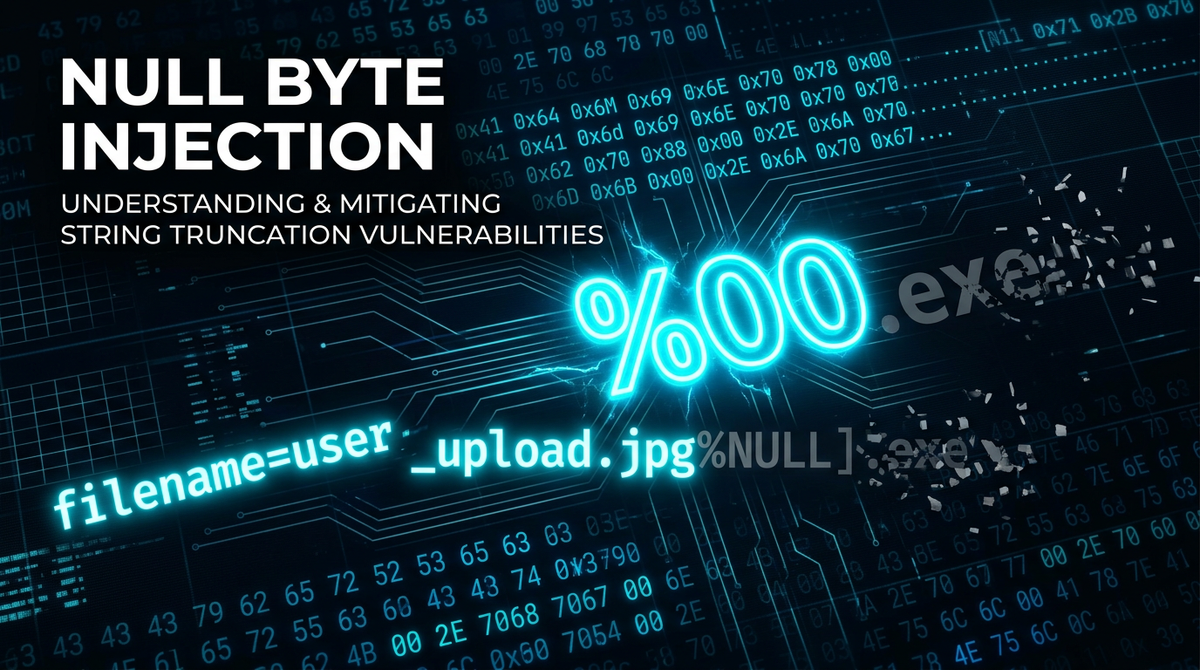
Null Byte Injection, also known as a Null Terminator Injection, is an attack where an attacker inserts a null character (\0 or %00 in URL encoding) into data used by an application. In many low-level programming languages like C and C++, the null character is used to signal the end of a string. When a high-level language like PHP (in older versions) or certain system APIs interact with these C-based underlying functions, they might stop processing the string at the null byte, while the application's validation logic might have looked at the entire string.
This discrepancy creates a security gap. For example, if an application checks if a filename ends in .jpg but then passes that filename to a system function that stops at a null byte, an attacker can trick the system into processing a file type that should have been blocked.
The Role of the Null Terminator
In the C programming language, strings are not objects with a length property; they are arrays of characters ending with a special character: 0x00 (the null byte). Functions like printf or fopen read the memory address of the string until they encounter this byte.
Modern high-level languages (like Java, Python, or modern PHP) usually track string length explicitly. However, many web servers, databases, and older runtimes still rely on C libraries for filesystem operations. This "translation" between a length-aware language and a null-terminated system call is where the injection occurs.
How Null Byte Injection Works in File Uploads
In a file upload scenario, the application usually performs two main tasks:
- Validation: Checking the file extension or MIME type against an allowlist.
- Storage: Moving the uploaded file to a permanent directory on the server.
If the validation logic is written in a way that scans the entire string, but the storage logic uses a C-based system call that respects the null terminator, an exploit is possible.
The Bypass Mechanism
Imagine an attacker wants to upload a PHP shell named webshell.php. The server only allows .jpg files. The attacker renames their file to webshell.php%00.jpg.
- Validation Phase: The application looks at the filename
webshell.php%00.jpg. It sees that it ends with.jpgand marks it as valid. - Storage Phase: The application calls a function like
move_uploaded_file()or a system-levelrename(). The operating system receives the path/var/www/uploads/webshell.php\0.jpg. Because the OS filesystem drivers are often written in C, they stop reading at the\0. - Result: The file is saved on the server as
webshell.php. The attacker can now navigate tohttps://example.com/uploads/webshell.phpand execute arbitrary code.
Technical Examples of Null Byte Exploitation
To understand this better, let's look at how this manifests in code and how an attacker might craft a payload.
Example 1: PHP File Extension Bypass (Legacy)
In older versions of PHP (specifically versions prior to 5.3.4), Null Byte Injection was a widespread issue. Consider the following vulnerable code snippet:
<?php
$target_dir = "uploads/";
$file_name = $_FILES["fileToUpload"]["name"];

// Basic validation: Check if it ends in .jpg
if (substr($file_name, -4) === ".jpg") {
    if (move_uploaded_file($_FILES["fileToUpload"]["tmp_name"], $target_dir . $file_name)) {
        echo "The file has been uploaded.";
    } else {
        echo "Sorry, there was an error uploading your file.";
    }
} else {
    echo "Only JPG files are allowed.";
}
?>
The Attack Payload:
An attacker sends a POST request with the filename: exploit.php%00.jpg.
The Logic Flow:
substr("exploit.php\0.jpg", -4)returns.jpg. The check passes.move_uploaded_fileis called with the destinationuploads/exploit.php\0.jpg.- The underlying filesystem API saves the file as
uploads/exploit.php.
Example 2: Local File Inclusion (LFI) with Null Byte
Null bytes aren't just for uploads; they are frequently used to bypass forced extensions in file inclusion vulnerabilities. If a script appends an extension to a user-provided path, the null byte can "cut off" that extension.
<?php
// Vulnerable code
$page = $_GET['page'];
include($page . ".php");
?>
If the attacker wants to read /etc/passwd, they can't just send ?page=/etc/passwd because the script would try to include /etc/passwd.php, which doesn't exist.
The Attack Payload:?page=/etc/passwd%00
The Logic Flow:
- The application constructs the string
/etc/passwd\0.php. - The
include()function (interacting with the C-based filesystem) sees the null byte and stops, attempting to open/etc/passwdinstead. This results in the sensitive file being leaked to the attacker.
Impact of Successful Exploitation
The impact of a Null Byte Injection in a file upload functionality is almost always critical. It typically leads to one of the following outcomes:
1. Remote Code Execution (RCE)
This is the most severe impact. By bypassing extension filters, an attacker can upload a web shell (PHP, ASPX, JSP, etc.). Once the shell is on the server, the attacker can execute system commands, browse the internal network, and gain full control over the web server.
2. Defacement
An attacker might upload an index.html or other static files to overwrite existing content on the website, leading to reputational damage.
3. Data Exfiltration
By combining Null Byte Injection with Path Traversal, an attacker might be able to write files to sensitive directories or read configuration files (like wp-config.php or .env files) that contain database credentials.
Detection and Prevention Strategies
While many modern languages have patched the direct Null Byte vulnerability in their core functions, it is still a risk in custom implementations, older environments, or when interacting with external binaries.
1. Update Your Runtime Environment
If you are using PHP, ensure you are on a version later than 5.3.4. Modern versions of PHP automatically throw an error or truncate the string safely when a null byte is detected in a file path. Similarly, ensure your web server (Apache, Nginx) and OS are patched.
2. Sanitize Input Aggressively
Never trust user-supplied filenames. Before processing a file, strip out any non-alphanumeric characters or specifically check for the null byte.
Example of sanitization in PHP:
$file_name = str_replace(chr(0), '', $file_name);
Example in Python:
if '\0' in filename:
    raise ValueError("Invalid filename detected")
3. Use Whitelisting for Extensions
Instead of checking if a string ends with a certain extension using simple string functions, use built-in path parsing libraries that are aware of these tricks.
Better PHP Validation:
$info = pathinfo($file_name);
$extension = strtolower($info['extension']);
$allowed = ['jpg', 'jpeg', 'png'];

if (in_array($extension, $allowed)) {
    // Proceed safely
}
4. Randomize Filenames
One of the best ways to prevent exploitation of uploaded files is to ignore the user-provided filename entirely. When a file is uploaded, generate a UUID or a random hash and store the file using that name, while keeping the original name in a database if necessary.
$new_name = bin2hex(random_bytes(16)) . ".jpg";
move_uploaded_file($tmp_path, "uploads/" . $new_name);
5. Disable Execution in Upload Directories
Configure your web server to treat the upload directory as a static-only zone. Even if an attacker successfully uploads a .php file using a null byte trick, the server will refuse to execute it and instead serve it as plain text or return a 403 Forbidden error.
Nginx Configuration Example:
location /uploads/ {
    location ~ \.php$ {
        deny all;
    }
}
Conclusion
Null Byte Injection is a classic example of how a fundamental difference in data handling between two layers of a system can lead to catastrophic security failures. While it is less common in modern, fully-updated stacks, it remains a vital concept for security professionals to understand, especially when dealing with legacy systems or complex integrations. By implementing strict input validation, using modern path-handling libraries, and randomizing filenames, you can effectively neutralize this threat.
To proactively monitor your organization's external attack surface and catch exposures like misconfigured upload directories before attackers do, try Jsmon.