What is IMAP Injection? Ways to Exploit, Examples and Impact
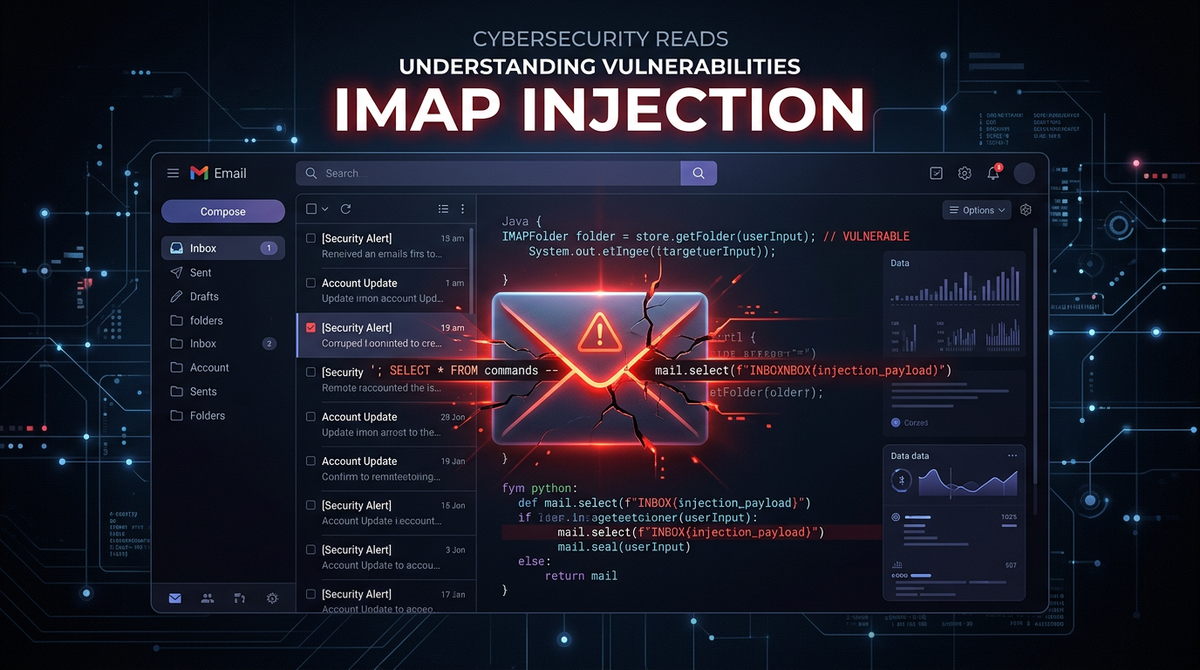
Internet Message Access Protocol (IMAP) is a foundational technology that allows email clients to communicate with mail servers. While it has been around for decades, it remains a critical part of our digital infrastructure. However, like many protocols that rely on text-based commands, it is susceptible to a specific class of vulnerability known as IMAP injection. In this guide, we will break down what IMAP injection is, how attackers exploit it, and what you can do to secure your infrastructure.
Understanding the Basics: What is IMAP?
Before diving into the mechanics of the injection, it is essential to understand the protocol itself. IMAP is used by email clients (like Outlook, Apple Mail, or Thunderbird) to retrieve messages from a mail server. Unlike POP3, which typically downloads and deletes mail from the server, IMAP synchronizes the state of the mailbox across multiple devices. When you mark an email as read on your phone, IMAP ensures it appears as read on your laptop.
IMAP operates over TCP port 143 (or 993 for SSL/TLS). It is a stateful protocol where the client sends commands, and the server responds. Every command sent by the client is usually prefixed with a unique identifier (a tag), such as A1, A2, etc. This allows the server to handle multiple requests asynchronously.
Common IMAP commands include:
LOGIN: Authenticates the user.SELECT: Opens a specific mailbox folder (e.g., INBOX).FETCH: Retrieves data associated with a message.SEARCH: Searches for messages matching specific criteria.LOGOUT: Ends the session.
What is IMAP Injection?
IMAP injection is a web security vulnerability that occurs when an application incorporates user-supplied data into an IMAP command without proper validation or escaping. It is functionally similar to SQL injection or Command Injection. By inserting control characters—specifically Carriage Return (\r or %0d) and Line Feed (\n or %0a)—an attacker can terminate the intended command and start a new, unauthorized command.
This vulnerability usually appears in webmail applications, contact forms that interact with mail servers, or administrative panels that allow users to configure email settings. If the backend code takes a username, folder name, or search query and concatenates it directly into an IMAP string, the door is open for exploitation.
How IMAP Injection Works
To understand the exploit, we must look at how an IMAP server interprets commands. The server treats a newline character as the end of one instruction and the beginning of the next.
The Vulnerable Code Scenario
Imagine a PHP-based webmail application that allows users to view different folders. The code might look like this:
$folder = $_GET['folder'];
$query = "A1 SELECT " . $folder;
// The application then sends $query to the IMAP server
Under normal circumstances, if a user selects the "Sent" folder, the application sends:A1 SELECT Sent
However, if an attacker provides a malicious input, they can manipulate the server's behavior.
The Anatomy of an Injection Payload
An attacker might provide the following string as the folder parameter:INBOX%0d%0aA2%20LOGOUT
When the application processes this, the resulting string sent to the IMAP server becomes:
A1 SELECT INBOX
A2 LOGOUT
The server sees two distinct commands. It first selects the INBOX, and then it immediately processes the LOGOUT command, effectively terminating the session. While logging out is harmless, this same technique can be used to read emails, delete folders, or bypass authentication.
Ways to Exploit IMAP Injection
Exploitation strategies vary depending on where the injection point is located. Below are some common techniques used by security researchers and attackers.
1. Authentication Bypass
If the injection point is in the login functionality, an attacker might be able to log in without a valid password. Suppose the application sends a command like:A1 LOGIN "username" "password"
If the application doesn't sanitize the username, an attacker could input:"admin" %0d%0aA2 CAPABILITY %0d%0aA3 LOGIN "user" "pass"
By carefully crafting the tags and the sequence of commands, the attacker might confuse the application logic into believing the primary authentication succeeded, or they might use the injected commands to discover server capabilities that shouldn't be visible before login.
2. Unauthorized Data Access (Information Disclosure)
This is the most common impact of IMAP injection. Attackers use the FETCH or SEARCH commands to extract sensitive information.
Consider a search feature in a webmail app:A1 SEARCH SUBJECT "[user_input]"
An attacker inputs: test"%0d%0aA2 FETCH 1:10 (BODY[TEXT])
The server receives:
A1 SEARCH SUBJECT "test"
A2 FETCH 1:10 (BODY[TEXT])
The server will return the full text of the first ten emails in the current folder, bypassing any restrictions the web application intended to place on the user's view.
3. Command Chaining for Account Takeover
In more complex scenarios, an attacker can use IMAP injection to modify account settings. For example, if the server supports certain extensions, an attacker might use the RENAME command to move a user's INBOX to a folder they control, or use APPEND to inject malicious emails into the user's mailbox (an "Email Injection" variant).
4. Bypassing Web Application Firewalls (WAF)
Because IMAP injection happens at the protocol level between the web server and the mail server, many traditional WAFs that only look for common SQL or XSS patterns might miss it. Attackers use various encoding techniques (like URL encoding or Base64) to hide the CRLF characters from simple filters.
Real-World Examples and Payloads
Let's look at specific payloads that demonstrate the power of this vulnerability.
Example: Listing All Folders
If an attacker wants to see the structure of a victim's mailbox, they can inject a LIST command.
Injection Point: ?mailbox=INBOX
Payload: INBOX%0d%0aA2%20LIST%20%22%22%20%22*%22
Resulting Commands:
A1 SELECT INBOX
A2 LIST "" "*"
The server will respond with a list of every folder in the account, potentially revealing folders like "Confidential," "Passwords," or "Legal."
Example: Reading Specific Messages
If an attacker knows (or guesses) a message ID, they can fetch the headers to see who the user is communicating with.
Payload: INBOX%0d%0aA2%20FETCH%20123%20BODY[HEADER]
Resulting Commands:
A1 SELECT INBOX
A2 FETCH 123 BODY[HEADER]
This reveals the From, To, Subject, and Date of message 123, providing valuable intelligence for phishing or social engineering attacks.
The Impact of IMAP Injection
The consequences of a successful IMAP injection attack can be devastating for both individuals and organizations:
- Data Breach: Exposure of sensitive emails, attachments, and contact lists.
- Privacy Violation: Unauthorized access to private communications.
- Compliance Failures: For industries regulated by GDPR, HIPAA, or PCI-DSS, an email breach can lead to massive fines and legal repercussions.
- Reputational Damage: Loss of customer trust when it becomes known that email data was compromised due to a preventable vulnerability.
- Pivot Point: Attackers often use compromised email accounts to reset passwords on other services, leading to a full digital identity takeover.
How to Detect IMAP Injection
Detecting these vulnerabilities requires a combination of manual testing and automated tools.
Manual Testing
Security researchers often look for parameters that seem to interact with a mail server. They will try injecting %0d%0a followed by a benign command like CAPABILITY or LOGOUT. If the application's response time changes or if the session ends abruptly, it is a strong indicator of an injection vulnerability.
Automated Scanning
Dynamic Application Security Testing (DAST) tools can be configured to fuzz parameters with CRLF sequences. However, because IMAP injection is context-dependent, custom scripts are often required to verify the vulnerability.
Prevention and Mitigation Strategies
Securing your application against IMAP injection follows the same principles as preventing other injection-based attacks.
1. Input Validation and Sanitization
Never trust user input. If a user is selecting a folder, validate the input against a strict whitelist of allowed folder names. If the input must be free-form (like a search query), ensure that you strip out or escape Carriage Return (\r) and Line Feed (\n) characters.
2. Use Secure Libraries and APIs
Instead of manually constructing IMAP command strings, use well-vetted libraries (like php-imap or Python's imaplib). These libraries often handle the underlying protocol details and can provide safer ways to pass arguments to commands, reducing the risk of manual string concatenation errors.
3. Principle of Least Privilege
Ensure that the IMAP credentials used by the web application have only the permissions necessary to perform their task. For example, if an application only needs to read emails, the IMAP user should not have administrative permissions to delete mailboxes or change server configurations.
4. Implement Multi-Factor Authentication (MFA)
While MFA doesn't stop the injection itself, it can prevent an attacker from using stolen credentials to access the IMAP server directly, limiting the scope of what they can achieve through the web application vulnerability.
5. Monitor and Audit Logs
Enable detailed logging on your IMAP server. Look for unusual patterns, such as multiple commands sharing the same connection in a very short timeframe or a high volume of FETCH commands originating from the web application server. Monitoring your external attack surface is also vital for identifying exposed mail interfaces.
Conclusion
IMAP injection is a classic example of how legacy protocols can become security liabilities when paired with modern web applications. By understanding the mechanics of CRLF injection and the structure of IMAP commands, developers can build more resilient systems. Remember: any time user input meets a protocol command, validation is not optional—it is a necessity.
To proactively monitor your organization's external attack surface and catch exposures before attackers do, try Jsmon.