What is Exposed Docker API? Ways to Exploit, Examples and Impact
Learn how exposed Docker APIs lead to host compromise. Explore exploitation examples, RCE techniques, and security best practices to protect your servers.
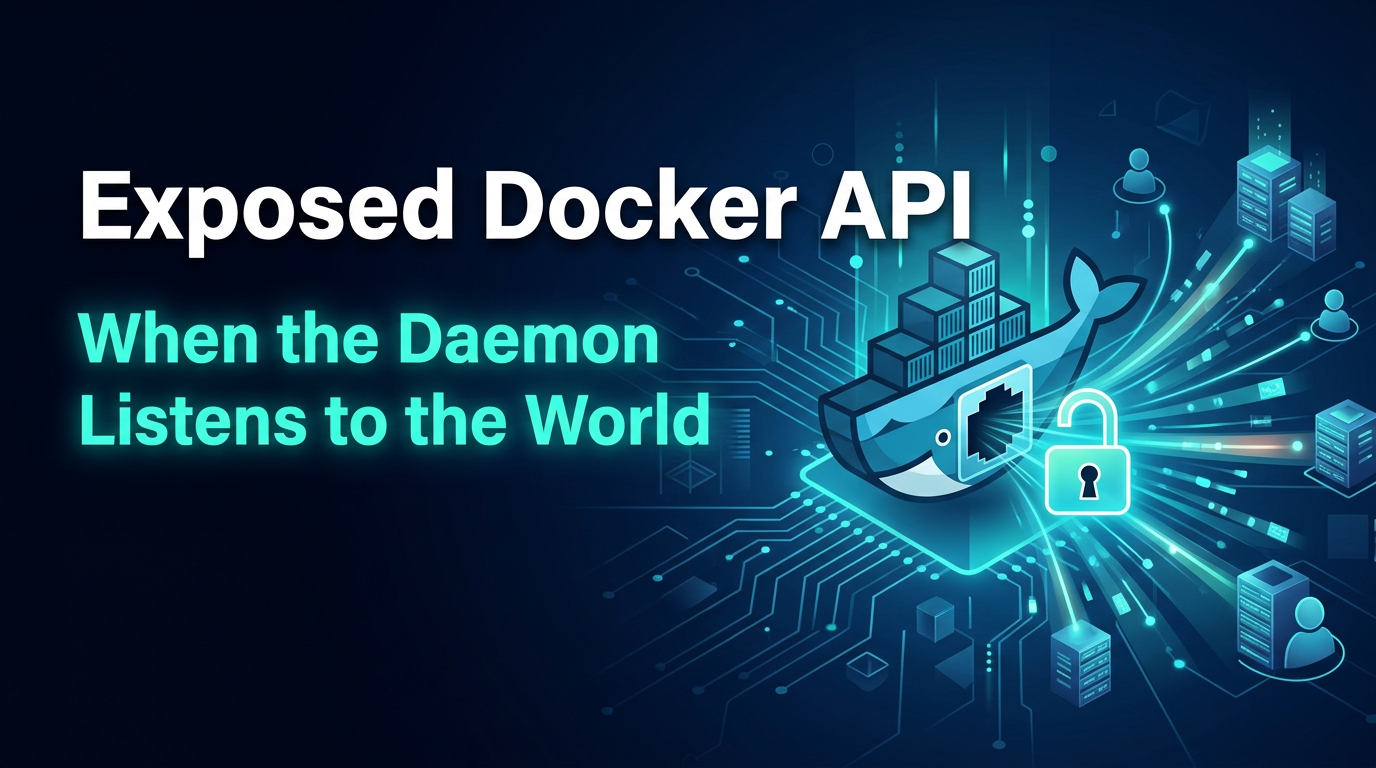
Docker has fundamentally changed the way we build, ship, and run applications. By abstracting the environment away from the hardware, it allows developers to maintain consistency across different stages of production. However, this convenience often comes with a significant security trade-off if the underlying infrastructure is not hardened correctly. One of the most critical misconfigurations in the container world is the Exposed Docker API. When the Docker Engine API is accessible over the network without proper authentication, it grants an attacker the same level of control as a root administrator on the host machine.
In this guide, we will break down what the Docker API is, why it gets exposed, how attackers identify and exploit it, and what you can do to protect your infrastructure. Whether you are a security beginner or a seasoned DevOps engineer, understanding this attack vector is essential for maintaining a secure external attack surface.
What is the Docker Engine API?
The Docker Engine API is a RESTful interface used by the Docker CLI and other tools to communicate with the Docker daemon (dockerd). By default, on most Linux distributions, the Docker daemon listens on a Unix domain socket at /var/run/docker.sock. This socket is local and requires root or docker group permissions to access.
However, there are scenarios where administrators want to manage Docker hosts remotely. To facilitate this, Docker can be configured to listen on a network socket (TCP). The common default ports for this are:
- Port 2375: Unencrypted, unauthenticated communication.
- Port 2376: Encrypted (TLS) communication.
The danger arises when port 2375 is opened to the public internet or an untrusted internal network without any form of authentication. Since the API was designed for functionality rather than security-by-default in remote scenarios, anyone who can reach the port can issue commands to the Docker daemon.
How Docker APIs Get Exposed
API exposure usually happens due to manual configuration errors during the setup of remote management tools or CI/CD pipelines. There are two primary ways an administrator might inadvertently expose the API:
1. Modifying the Systemd Unit File
On many systems, administrators edit the Docker service file (usually located at /lib/systemd/system/docker.service) to add the -H flag. A common (and dangerous) configuration looks like this:
ExecStart=/usr/bin/dockerd -H fd:// -H tcp://0.0.0.0:2375
Setting the host to 0.0.0.0 instructs Docker to listen on all available network interfaces. If the server has a public IP and no firewall rules are in place, the API is now global.
2. The daemon.json Configuration
Alternatively, users might use the /etc/docker/daemon.json file to configure the daemon. A vulnerable configuration would look like this:
{
  "hosts": ["unix:///var/run/docker.sock", "tcp://0.0.0.0:2375"]
}
While this makes remote management easy, it effectively removes the security perimeter of the container host.
How to Identify an Exposed Docker API
Attackers and security researchers use several methods to find these exposures. Identifying an exposed API is the first step in both offensive operations and defensive auditing.
Scanning with Nmap
Nmap is the industry standard for network discovery. To find Docker APIs, an attacker might scan for port 2375:
nmap -sV -p 2375 <target-ip-range>
If the port is open, Nmap will often identify the service as docker or http and provide the version of the Docker Engine.
Using CURL for Verification
Once a potential target is found, a simple curl command can confirm if the API is truly open and unauthenticated. The /version and /info endpoints are common starting points:
curl http://<target-ip>:2375/version
If the server returns a JSON object containing the Docker version, Go version, and OS details, the API is exposed. An even more revealing endpoint is /containers/json, which lists all running containers:
curl http://<target-ip>:2375/containers/json
Search Engines for Devices
Platforms like Shodan, Censys, and Zoomeye constantly crawl the internet for open ports. A simple query like port:2375 on Shodan reveals thousands of exposed Docker instances worldwide.
Technical Exploitation Scenarios
An exposed Docker API is not just a leak of information; it is a direct path to Remote Code Execution (RCE). Here is how an attacker moves from discovery to full host compromise.
Scenario 1: Information Gathering
Before launching an exploit, an attacker will list the available images and containers to understand the environment. This helps them identify if the host is a production server, a database, or a development machine.
# List all images on the remote host
docker -H tcp://<target-ip>:2375 images

# List all containers (including stopped ones)
docker -H tcp://<target-ip>:2375 ps -a
Scenario 2: Remote Code Execution (RCE)
If the API is open, the attacker can use their local Docker CLI to run commands on the remote server. They can pull a lightweight image like alpine and execute commands inside it.
docker -H tcp://<target-ip>:2375 run alpine cat /etc/passwd
In this example, the attacker has successfully executed a command on the remote infrastructure. However, they are still trapped inside a container. The next step is to escape to the host.
Scenario 3: Host Takeover via Volume Mounting
This is the most critical exploitation path. Because the Docker daemon runs as root, any container it starts can be granted access to the host's file system. An attacker can mount the host's root directory (/) into a container and then use chroot to effectively become root on the host.
The Attack Command:
docker -H tcp://<target-ip>:2375 run -it -v /:/mnt/host alpine chroot /mnt/host /bin/sh
Breakdown of the command:
-H tcp://<target-ip>:2375: Directs the command to the vulnerable remote host.run -it: Starts an interactive session.-v /:/mnt/host: Mounts the entire host file system into the container at/mnt/host.alpine: Uses a small, common image.chroot /mnt/host /bin/sh: Changes the root directory of the session to the host's filesystem and opens a shell.
At this point, the attacker has a shell with root privileges on the physical or virtual server. They can read sensitive files (like /etc/shadow), install backdoors, or steal SSH keys.
Scenario 4: Deploying Malicious Workloads
Often, attackers don't want to steal data but rather use the server's compute power. They deploy "cryptojacking" containers that mine Monero or other cryptocurrencies. Because they can control the API, they can deploy hundreds of containers across an entire cluster in seconds.
The Real-World Impact
The impact of an exposed Docker API is almost always "Critical." The consequences include:
- Total Data Breach: Access to the host means access to all databases, environment variables (containing API keys and secrets), and source code stored on the machine.
- Ransomware: Attackers can encrypt the host's filesystem or delete all Docker volumes and demand payment for recovery.
- Lateral Movement: Once an attacker controls a Docker host, they can use it as a pivot point to attack other internal systems that are not exposed to the internet.
- Resource Hijacking: Massive cloud bills resulting from unauthorized cryptocurrency mining.
- Supply Chain Attacks: If the exposed host is part of a CI/CD pipeline, attackers can inject malicious code into the container images that your company distributes to customers.
Prevention and Mitigation Strategies
Securing the Docker API should be a priority for any organization using containerization. Here are the best practices to prevent exposure:
1. Never Expose the API to the Internet
If you do not absolutely need remote access via TCP, don't enable it. Stick to the default Unix socket. If you must manage Docker remotely, use SSH tunneling instead of opening a port.
Example of SSH Tunneling:
export DOCKER_HOST=ssh://user@remote-host
docker ps
This routes your Docker commands securely over SSH, leveraging your existing SSH keys and user permissions.
2. Enable TLS Authentication
If TCP access is mandatory, you must use TLS. This ensures that only clients with a valid certificate signed by your trusted Certificate Authority (CA) can communicate with the API. This changes the port to 2376 and adds a layer of mutual authentication.
3. Use Firewalls and Security Groups
Never rely on application-level security alone. Use iptables, ufw, or cloud security groups (like AWS SGs) to restrict access to port 2375/2376 to specific, trusted IP addresses.
4. Implement the Principle of Least Privilege
Avoid running the Docker daemon as root if possible (Rootless mode). Additionally, use authorization plugins to restrict which API endpoints specific users can call.
5. Continuous Monitoring
Misconfigurations happen. A developer might temporarily open a port for debugging and forget to close it. This is where automated reconnaissance becomes vital.
To proactively monitor your organization's external attack surface and catch exposures before attackers do, try Jsmon. Jsmon can help you identify open ports and misconfigured services across your entire infrastructure, ensuring that a simple Docker configuration error doesn't turn into a headline-making data breach.
Conclusion
An exposed Docker API is one of the most "rewarding" finds for an attacker because it provides a direct, high-privilege path into the heart of an organization's infrastructure. By understanding the mechanics of how the API works and the common ways it is misconfigured, security teams can better defend their environments. Remember: convenience should never come at the cost of visibility. Regularly audit your Docker configurations, use secure transport methods like SSH, and leverage tools like Jsmon to maintain a clean and secure attack surface.