What is Credential Stuffing? Ways to Exploit, Examples and Impact
Discover how credential stuffing works, technical ways attackers exploit leaked data, and actionable steps to prevent account takeover on your platform.
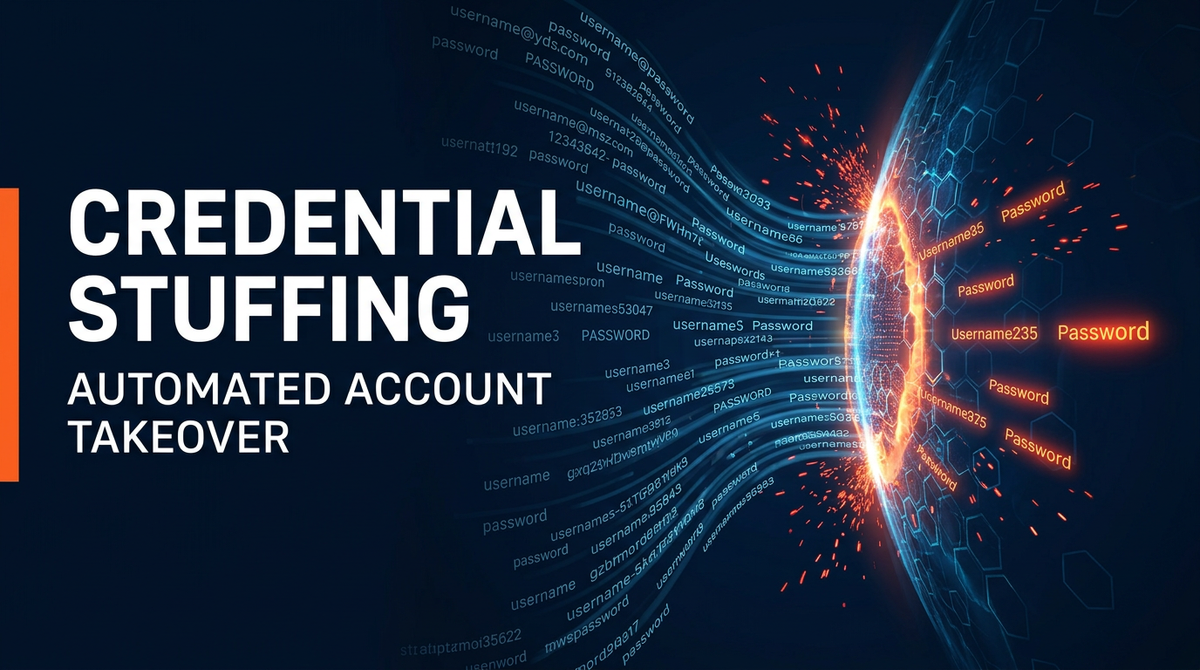
In an era where data breaches occur with alarming frequency, the credentials stolen from one platform often become the keys to another. Credential stuffing is a sophisticated yet structurally simple cyberattack that leverages the common human tendency to reuse passwords across multiple services. By automating the login process using millions of leaked username and password pairs, attackers can compromise accounts at scale, leading to significant financial and reputational damage.
What is Credential Stuffing?
Credential stuffing is a type of cyberattack where automated tools are used to test large lists of stolen login credentials (known as "combo lists") against various online services. This technique relies on the assumption that many users employ the same password for their email, social media, banking, and corporate accounts.
Unlike traditional hacking methods that target a specific individual or a vulnerability in a web application's code, credential stuffing targets the user's behavior. If a user’s credentials were leaked in a breach of a minor gaming forum, an attacker might "stuff" those same credentials into the login portals of major banks or retail sites. If the user reused that password, the attacker gains unauthorized access without ever having to "crack" a password.
Credential Stuffing vs. Brute Force Attacks
While they are often confused, credential stuffing and brute force attacks are distinct methodologies. Understanding the difference is crucial for implementing the right defenses.
Brute Force Attacks
In a traditional brute force attack, an attacker attempts to guess a password for a specific account by trying every possible combination of characters (e.g., aaaa1, aaaa2, aaaa3). This is computationally expensive and easily detected by modern account lockout policies.
Dictionary Attacks
A subset of brute force, dictionary attacks use a list of commonly used passwords (like "password123" or "qwerty") against a specific username.
Credential Stuffing
Credential stuffing is more surgical. The attacker already has a valid pair of credentials; they just don't know which other services those credentials work on. Because the attacker is using "correct" passwords, they often bypass simple security filters that look for failed login patterns on a single account. Instead, they spread their attempts across thousands of different accounts to stay under the radar of rate-limiting systems.
The Lifecycle of a Credential Stuffing Attack
To understand how to defend against these attacks, we must first look at the workflow an attacker follows. A typical campaign consists of four primary stages:
- Acquisition of Combo Lists: Attackers obtain lists of leaked credentials from the dark web, Telegram channels, or public paste sites. These lists often contain millions of entries in the format
username:passwordoremail:password. - Tooling and Infrastructure: The attacker sets up automation software and a network of proxies. Proxies are essential to hide the attacker's true IP address and to distribute the login requests, making them appear as if they are coming from thousands of different legitimate users.
- The "Checking" Phase: The automation tool (often called a "checker") sends HTTP requests to the target website’s login API. The tool parses the server's response to determine if the login was successful (e.g., an HTTP 302 redirect to a dashboard vs. an HTTP 401 Unauthorized error).
- Monetization: Successful logins (called "hits") are saved. The attacker then drains bank accounts, steals personal data, uses stored credit cards to make purchases, or sells the validated accounts on underground marketplaces.
Technical Example: How an Attack Looks
From a technical perspective, a credential stuffing tool mimics a legitimate browser. Below is a simplified example of how an attacker might use Python to automate the checking of credentials against a hypothetical login endpoint.
import requests

# A small sample of a 'combo list'
credentials = [
    ("admin@example.com", "Password123"),
    ("user2@test.com", "Summer2023!"),
    ("victim@domain.com", "p@ssword")
]

login_url = "https://api.target-site.com/v1/login"

for username, password in credentials:
    payload = {
        "user": username,
        "pass": password
    }

    # Attackers often use custom headers to mimic real browsers
    headers = {
        "User-Agent": "Mozilla/5.0 (Windows NT 10.0; Win64; x64) Chrome/114.0.0.0",
        "Content-Type": "application/json"
    }

    response = requests.post(login_url, json=payload, headers=headers)

    if response.status_code == 200 and "token" in response.text:
        print(f"[SUCCESS] Valid credentials found: {username}:{password}")
    else:
        print(f"[FAILED] {username}")
In a real-world scenario, the attacker would use libraries like asyncio for high-speed concurrent requests and rotate through thousands of residential proxies to bypass IP-based rate limiting.
Common Tools Used by Attackers
While custom scripts are common, many attackers use specialized "All-in-One" (AiO) tools that come pre-configured with modules for popular websites. Some of the most well-known include:
- OpenBullet / SilverBullet: Flexible web testing suites that allow users to create "configs" for specific websites. They handle proxy rotation, CAPTCHA solving integration, and result parsing.
- Sentry MBA: An older but still widely used tool for automated account checking.
- Custom Botnets: Advanced threat actors may use botnets comprised of compromised IoT devices to launch massive distributed credential stuffing campaigns that are incredibly difficult to distinguish from legitimate traffic.
The Impact of Credential Stuffing
The consequences of a successful credential stuffing attack extend beyond just the individual user. Organizations face massive operational and financial hurdles.
For the Organization
- Financial Loss: Costs associated with fraud reimbursement, legal fees, and regulatory fines (such as GDPR or CCPA violations).
- Reputational Damage: Loss of customer trust is often the most expensive outcome. Users are unlikely to return to a service they perceive as insecure.
- Operational Strain: Customer support teams become overwhelmed with tickets from users locked out of their accounts, and security teams must spend hundreds of hours on incident response.
For the User
- Identity Theft: Attackers gain access to PII (Personally Identifiable Information) which can be used for further crimes.
- Financial Theft: Direct access to linked credit cards, loyalty points, or bank balances.
- Data Loss: Deletion or modification of personal files, emails, and photos.
How to Detect and Prevent Credential Stuffing
Defending against credential stuffing requires a multi-layered approach that combines technical controls with user education.
1. Implement Multi-Factor Authentication (MFA)
MFA is the single most effective defense against credential stuffing. Even if an attacker has a valid username and password, they cannot access the account without the second factor (e.g., a TOTP code, SMS, or hardware key). While attackers are finding ways to bypass some MFA methods, it still stops the vast majority of automated attacks.
2. Use CAPTCHAs and Bot Detection
Modern CAPTCHA services (like reCAPTCHA v3 or Cloudflare Turnstile) use behavioral analysis to distinguish between humans and bots. By analyzing mouse movements, typing speed, and browser fingerprints, these tools can block automated login attempts before they even reach your backend.
3. Rate Limiting and IP Reputation
Implement strict rate limiting on your login endpoints. However, because attackers use proxies, you cannot rely solely on limiting a single IP address. You should also monitor for "low and slow" attacks and block traffic coming from known malicious proxies or TOR exit nodes.
4. Monitor for Leaked Credentials
Organizations can proactively check if their users' credentials have appeared in recent breaches. Services like Jsmon can help you understand your external attack surface, ensuring you are aware of exposed assets that might be targeted by credential stuffing bots. If you find that a batch of your users' emails are in a new breach, you can trigger a mandatory password reset for those specific accounts.
5. Device Fingerprinting
By collecting information about the user's browser, operating system, and hardware, you can create a unique "fingerprint" for their device. If a login attempt occurs with valid credentials but from a completely new and suspicious device fingerprint, you can trigger additional security checks.
Real-World Examples
Several high-profile companies have fallen victim to credential stuffing in recent years:
- The 2022 PayPal Incident: Thousands of PayPal accounts were accessed via credential stuffing, allowing attackers to view full names, dates of birth, and social security numbers. PayPal responded by resetting passwords and enhancing their monitoring.
- The Disney+ Launch: Shortly after Disney+ launched, thousands of accounts were taken over by credential stuffing. Many of these accounts were immediately put up for sale on dark web forums for as little as $3.
- Chick-fil-A: In early 2023, the fast-food giant confirmed that a credential stuffing attack had compromised the accounts of over 70,000 customers, leading to the theft of loyalty points and stored payment information.
Conclusion
Credential stuffing is a persistent threat because it exploits a fundamental weakness in human psychology: the desire for convenience. As long as users reuse passwords, attackers will continue to automate the process of testing leaked credentials. For technical professionals, the goal is to make the cost of the attack higher than the potential reward. By implementing MFA, robust bot detection, and proactive attack surface management, you can significantly reduce your organization's risk.
To proactively monitor your organization's external attack surface and catch exposures before attackers do, try Jsmon.