What is Carding Attack? Ways to Exploit, Examples and Impact
Learn how carding attacks work, how attackers use bots to validate stolen cards, and technical ways to protect your business from e-commerce fraud.
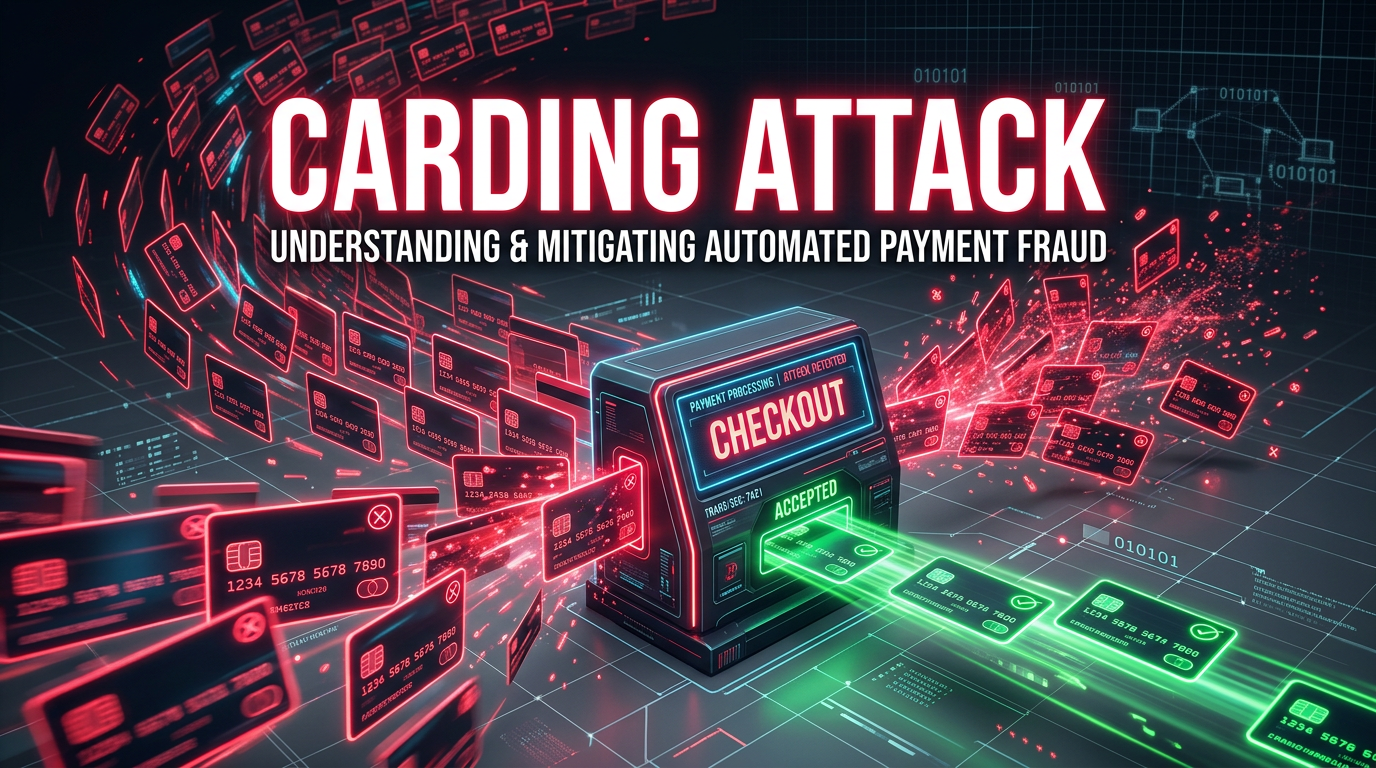
In the digital age, financial fraud has evolved from physical pickpocketing to sophisticated, automated cyberattacks. One of the most persistent and damaging threats to e-commerce platforms today is the carding attack. This automated form of credit card fraud allows cybercriminals to validate thousands of stolen card details in minutes, leading to massive financial losses for businesses and consumers alike.
What is Carding?
Carding is a type of cyberattack where criminals use automated bots to test the validity of stolen credit card information. The primary goal is to identify which cards from a stolen database are still active and have sufficient credit limits for further exploitation. Once a card is "validated"—meaning a small transaction or a verification check succeeds—the attacker can use it to purchase high-value goods, gift cards, or sell the "live" card data on the dark web for a premium.
While the term "carding" is often used broadly to describe credit card fraud, in the context of cybersecurity, it specifically refers to the automated process of "card stuffing" or "card cracking." Attackers take advantage of the checkout processes on e-commerce sites, donation portals, or subscription services to run their validation scripts.
How Carding Attacks Work: The Lifecycle
A carding attack is rarely a standalone event; it is part of a larger ecosystem of cybercrime. Understanding the lifecycle of these attacks is crucial for security professionals and developers.
1. Data Acquisition
Attackers obtain bulk lists of credit card numbers (Primary Account Numbers or PANs) through various means. These include data breaches of large retailers, phishing campaigns, or "skimming" (where malware is injected into a website's payment page). These lists often contain thousands of records, but many of the cards may have been canceled or expired.
2. The Validation Phase (Card Stuffing)
This is where the actual carding attack occurs. Using botnets or specialized software, the attacker targets a website's payment gateway. The bot automatically enters the card details and attempts a small transaction—often as low as $1.00. If the transaction is approved, the bot logs the card as "live."
3. Cashing Out
Once the attacker has a list of validated cards, they move to the "cashing out" phase. This involves purchasing physical goods (which are later resold), buying digital gift cards (which are hard to track), or using the cards to fund other criminal activities. In many cases, the validated list is simply sold back to other criminals on underground forums.
Technical Methods of Exploitation
Carding attacks rely on automation. Attackers don't sit and type card numbers manually; they use sophisticated scripts that can bypass simple security measures.
Card Cracking (Brute Forcing)
In card cracking, the attacker may have the 16-digit card number but lacks the expiration date or the CVV (Card Verification Value). They use bots to systematically guess these missing pieces of information. Since there are only 12 months and a few years of likely expiration, and only 1,000 possible CVV combinations (000-999), a high-speed bot can crack a card in seconds if the merchant does not have rate limiting in place.
API Abuse
Modern e-commerce sites often use APIs to handle payments. Attackers target these API endpoints directly, bypassing the frontend user interface. This allows them to send requests much faster and often avoid JavaScript-based bot detection tools.
Example: A Simple Carding Bot Logic
Below is a conceptual example of how a carding bot might be structured using Python. Note that this is for educational and defensive purposes to help developers understand the traffic patterns they need to block.
import requests
import time

# A list of stolen card data (PAN, Expiry, CVV)
stolen_cards = [
    {"pan": "4111222233334444", "exp": "12/25", "cvv": "123"},
    {"pan": "5222333344445555", "exp": "01/26", "cvv": "456"},
    # ... thousands more
]

# Target payment endpoint
target_url = "https://example-shop.com/api/checkout/validate"

def test_card(card):
    payload = {
        "card_number": card['pan'],
        "expiry": card['exp'],
        "cvv": card['cvv'],
        "amount": 1.00  # Small validation amount
    }

    try:
        response = requests.post(target_url, json=payload, timeout=5)
        if "success" in response.text.lower():
            print(f"[+] VALID CARD FOUND: {card['pan']}")
            return True
        else:
            print(f"[-] Declined: {card['pan']}")
            return False
    except Exception as e:
        print(f"[!] Error: {e}")

for card in stolen_cards:
    test_card(card)
    time.sleep(0.5) # Slight delay to avoid simple rate limits
Real-World Impact of Carding Attacks
The impact of carding extends far beyond the initial fraudulent transaction. It creates a ripple effect that damages every party involved.
Impact on Businesses and Merchants
- Chargeback Fees: When a legitimate cardholder notices a fraudulent $1.00 charge, they dispute it. The merchant is not only forced to refund the money but is also hit with a chargeback fee from the bank (often $20–$50 per instance). If thousands of cards are tested, these fees can bankrupt a small business.
- Reputational Damage: If a merchant's site is frequently used for carding, payment processors may label them as "high risk." This can lead to higher processing fees or the total termination of their merchant account.
- Infrastructure Strain: High-volume carding bots can mimic a Distributed Denial of Service (DDoS) attack, slowing down the website for legitimate customers and increasing server costs.
Impact on Consumers
While banks usually protect consumers from the final cost of fraud, the process of canceling cards, disputing charges, and monitoring credit reports is stressful and time-consuming. Furthermore, carding is often a precursor to full-scale identity theft.
How to Detect Carding Activity
Detecting carding requires monitoring for specific technical anomalies. Security teams should look for the following patterns:
- High Velocity of Failed Transactions: A sudden spike in payment failures, particularly from the same IP address or user agent, is a classic sign of carding.
- Small Transaction Amounts: Bots often test cards with very small amounts ($0.01 to $5.00) to avoid triggering bank alerts.
- Mismatched Geolocation: If the IP address of the user is in one country but the card's issuing bank is in another, this increases the risk score.
- Abnormal User Behavior: Bots often navigate directly to the checkout page without browsing products or adding items to a cart in a natural sequence.
- Inconsistent HTTP Headers: Many bots use outdated libraries (like Python's
requestsorcurl) that have distinct header signatures compared to modern browsers like Chrome or Firefox.
Prevention and Mitigation Strategies
Defending against carding requires a multi-layered approach. No single tool can stop a determined attacker, but a combination of technical controls can make the attack too expensive or difficult to continue.
1. Implement Rate Limiting
Rate limiting is the first line of defense. You should limit the number of payment attempts allowed from a single IP address, device ID, or user account within a specific timeframe. For example, blocking any IP that attempts more than three failed checkouts in ten minutes can stop basic bots.
2. Use CAPTCHA and Bot Management
Integrating tools like reCAPTCHA v3 or specialized bot management solutions can help distinguish between human shoppers and automated scripts. Modern bot managers look at mouse movements, typing speed, and browser fingerprints to identify automation.
3. Implement 3D Secure (3DS)
3D Secure adds an extra layer of authentication, such as a one-time password (OTP) sent to the user's phone. While this can add friction to the checkout process, it is highly effective at stopping automated carding.
4. Velocity Checks on the Backend
Beyond simple IP rate limiting, implement velocity checks based on card attributes. If you see the same BIN (Bank Identification Number—the first 6 digits of a card) being used repeatedly across different accounts, it likely indicates a carding run using a specific stolen batch.
5. Address Verification System (AVS)
Enforce AVS checks where the billing address provided by the user must match the address on file with the credit card issuer. Most carding bots do not have accurate address data, causing these checks to fail.
The Role of Infrastructure Monitoring
Carding attacks often target forgotten or shadow IT infrastructure—old staging sites or API endpoints that aren't as heavily guarded as the main production site. Attackers look for the path of least resistance. This is why maintaining a clear view of your external attack surface is vital.
By identifying every publicly accessible endpoint, security teams can ensure that rate limiting and bot protection are applied consistently across the entire organization. If an attacker finds a single unprotected "test" payment gateway, they can validate their entire database through that loophole.
Conclusion
Carding attacks are a sophisticated, automated threat that can cause significant financial and reputational harm. For e-commerce businesses, the cost of inaction is high, ranging from massive chargeback fees to the loss of payment processing capabilities. By understanding the technical mechanics of how bots exploit payment gateways and implementing robust defenses like rate limiting, bot detection, and velocity checks, organizations can protect themselves and their customers.
To proactively monitor your organization's external attack surface and catch exposures before attackers do, try Jsmon.