What is Broken Function Level Authorization (BFLA)? Ways to Exploit, Examples and Impact
Learn about Broken Function Level Authorization (BFLA), its impact, and how to prevent this critical API security flaw with technical examples and best practices.
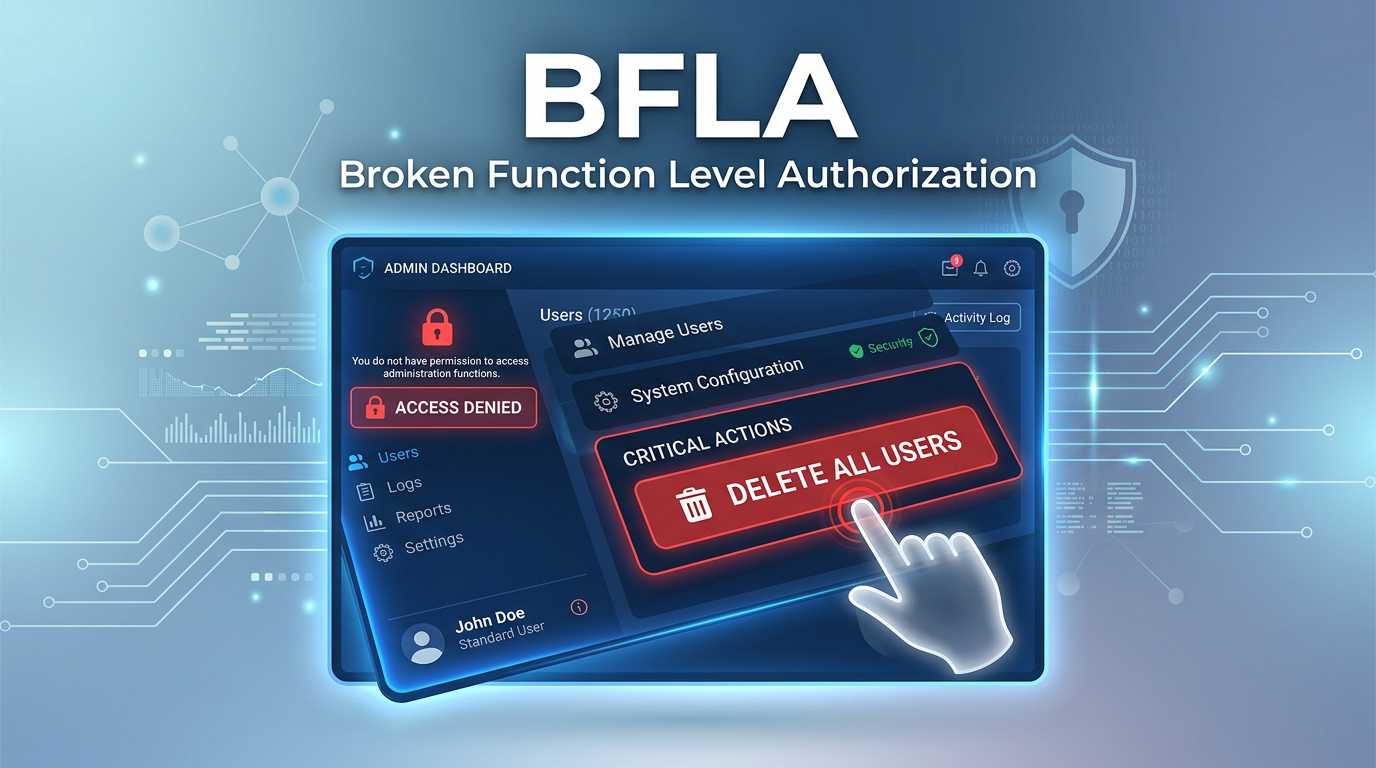
Broken Function Level Authorization (BFLA) is a critical security vulnerability where an application fails to properly verify if a user has the necessary permissions to perform a specific action or access a particular function. In the modern landscape of microservices and complex APIs, BFLA has become one of the most prevalent risks, often allowing regular users to execute administrative tasks, delete data, or access sensitive configuration settings. Understanding how BFLA works is essential for any developer or security professional looking to harden their infrastructure against unauthorized access.
Understanding Broken Function Level Authorization (BFLA)
At its core, Broken Function Level Authorization occurs when an application relies on the client to tell it what functions it can perform, or when the server-side checks are inconsistent across different API endpoints. While Authentication (AuthN) verifies who a user is, Authorization (AuthZ) determines what that user is allowed to do. BFLA is a failure of the latter.
In many applications, there are different tiers of users: guests, standard users, managers, and administrators. Each tier should have access to a specific subset of functions. For instance, a standard user might be able to GET /api/v1/profile, but only an administrator should be able to DELETE /api/v1/users/123. If the system allows a standard user to successfully call the DELETE endpoint simply by knowing the URL, the system suffers from BFLA.
This vulnerability is frequently listed in the OWASP Top 10 for API Security (API3:2023) because APIs often expose a wide array of endpoints that are sometimes overlooked during security reviews. Developers might assume that because a button is hidden in the UI for non-admin users, the underlying API is secure. However, attackers do not use the UI; they interact directly with the API.
BFLA vs. BOLA: What is the Difference?
It is common to confuse Broken Function Level Authorization (BFLA) with Broken Object Level Authorization (BOLA), also known as IDOR. While they are related, they target different aspects of access control.
- BOLA (Broken Object Level Authorization): This occurs when a user accesses a resource (an object) they shouldn't have access to, but using a function they are allowed to use. For example, User A uses
GET /api/v1/messages/101to read their own message, but then changes the ID toGET /api/v1/messages/102to read User B's message. The function (viewing a message) is valid for the user, but the object (message 102) is not. - BFLA (Broken Function Level Authorization): This occurs when a user accesses a function that is outside their assigned role. For example, a regular user attempts to call
POST /api/v1/admin/export-all-data. The user shouldn't be able to trigger the "export" function regardless of which object they are targeting.
In short: BOLA is about unauthorized access to data, while BFLA is about unauthorized access to actions.
How BFLA Vulnerabilities Manifest in Modern Apps
BFLA vulnerabilities typically stem from architectural oversights or the complexity of managing permissions across hundreds of endpoints. Here are the most common reasons they occur:
1. Inconsistent Authorization Checks
In a large application, different teams might develop different modules. If one team implements strict role-based access control (RBAC) but another team forgets to apply the middleware to their new administrative endpoints, a BFLA vulnerability is born. The application might secure the POST method but forget to secure the PUT or DELETE methods for the same resource.
2. Security Through Obscurity
Some developers believe that if an administrative URL is "unpredictable" or not linked anywhere in the main application, it is safe. They might use endpoints like /api/v1/system-internal-admin-panel-99. However, attackers use directory brute-forcing, Jsmon for reconnaissance, and JavaScript source code analysis to discover these hidden paths.
3. Relying on Client-Side Validation
This is a classic mistake where the frontend code checks the user's role and hides the "Admin Settings" tab if the user is not an admin. While this provides a good user experience, it provides zero security. If the backend API does not perform the same check, an attacker can simply send a manual HTTP request to the admin endpoint.
Common Ways to Exploit BFLA (With Examples)
Exploiting BFLA involves discovering endpoints and testing them with different privilege levels. Here are practical technical examples of how these attacks are carried out.
Method 1: Changing HTTP Verbs
Sometimes, an application only protects the most obvious HTTP methods. A developer might secure POST /api/users to prevent unauthorized creation, but forget to secure GET /api/users (allowing data leakage) or PATCH /api/users/1 (allowing unauthorized modification).
Example Scenario:
A user is logged in as a "Viewer." They see a request in their browser history:GET /api/v1/accounts/12345 (Returns account details)
The attacker attempts to change the method to DELETE:
DELETE /api/v1/accounts/12345
Host: example.com
Authorization: Bearer <Viewer_JWT_Token>
If the server processes this and deletes the account, BFLA is present because a "Viewer" should not have the "Delete" function available.
Method 2: Accessing Hidden Administrative Endpoints
Attackers often look for patterns in API design. If they see /api/v1/user/profile, they might guess that /api/v1/admin/profile or /api/v1/user/all exists.
Example Scenario:
An attacker finds a JavaScript file that contains the following code snippet:
async function fetchAdminStats() {
  const response = await fetch('/api/v2/admin/dashboard-metrics');
  // ... render data
}
Even if the "Admin Dashboard" is not visible in the UI, the attacker can now target /api/v2/admin/dashboard-metrics directly using their standard user session cookie. If the backend doesn't verify the user's role, the attacker gains access to sensitive business metrics.
Method 3: Parameter Tampering for Role Escalation
In some cases, the function itself is accessible, but it takes a parameter that determines the privilege level of the action.
Example Scenario:
A user registers for an account and observes the following request:
POST /api/v1/register
Content-Type: application/json

{
  "username": "attacker",
  "password": "password123",
  "email": "attacker@example.com"
}
The attacker tries to add a role parameter to the request:
POST /api/v1/register
Content-Type: application/json

{
  "username": "attacker",
  "password": "password123",
  "email": "attacker@example.com",
  "role": "admin"
}
If the backend blindly maps the input JSON to the user database model without filtering out protected fields, the attacker has successfully exploited BFLA to grant themselves administrative privileges.
The Impact of BFLA Vulnerabilities
The consequences of Broken Function Level Authorization can be devastating for an organization. Because BFLA often involves administrative or high-privilege functions, the impact is usually much broader than a single user's data.
- Full System Compromise: If an attacker can access functions that manage users, they can promote themselves to super-admins, effectively taking over the entire platform.
- Data Exfiltration: BFLA often allows access to "Export All" or "Bulk Download" functions that are intended for data backups or reporting, leading to massive data breaches.
- Data Corruption: Unauthorized access to
DELETEorUPDATEfunctions allows attackers to wipe databases, change pricing on e-commerce sites, or manipulate financial records. - Reputational Damage: News of a breach caused by simple authorization failures can destroy customer trust and lead to legal penalties under regulations like GDPR or CCPA.
How to Prevent BFLA in Your Infrastructure
Preventing BFLA requires a "Deny by Default" mindset and a centralized approach to authorization logic. Here are the best practices for developers and security teams:
1. Implement Robust Role-Based Access Control (RBAC)
Every function in your application should be mapped to one or more roles. Before any business logic is executed, the application must check if the current user's role matches the required role for that function.
Example (Node.js/Express Middleware):
const authorize = (roles = []) => {
  return (req, res, next) => {
    // Ensure user is authenticated first
    if (!req.user) return res.status(401).json({ message: 'Unauthorized' });

    // Check if user role is in the allowed list
    if (roles.length && !roles.includes(req.user.role)) {
      return res.status(403).json({ message: 'Forbidden: Insufficient Permissions' });
    }

    next();
  };
};

// Usage
app.delete('/api/v1/users/:id', authorize(['admin']), (req, res) => {
  // Only users with 'admin' role can reach this code
  deleteUser(req.params.id);
  res.send('User deleted');
});
2. Centralize Authorization Logic
Avoid writing authorization checks inside every individual controller or function. Instead, use centralized middleware or an authorization service. This ensures that security policies are applied consistently across the entire API surface.
3. Use an Internal API Gateway
For microservices, use an API gateway that handles authorization at the edge. This prevents internal services from being exposed without a mandatory check on the user's claims and roles.
4. Regular Security Auditing and Reconnaissance
Automated tools and manual penetration testing are vital. You need to know what endpoints exist before you can secure them. Using tools like Jsmon helps you map your attack surface and identify newly exposed endpoints that might have been pushed to production without proper authorization controls.
5. Disable Unused HTTP Methods
If an endpoint only needs to support GET, explicitly disable POST, PUT, and DELETE. Most modern web frameworks allow you to define allowed methods strictly, reducing the surface area for BFLA attacks.
Conclusion
Broken Function Level Authorization (BFLA) is a deceptive vulnerability. It doesn't rely on complex memory corruption or cryptographic flaws; it relies on simple logic errors and the assumption that "if they can't see the link, they won't find the function." As applications grow in complexity, the risk of missing an authorization check on a single administrative endpoint increases exponentially.
By implementing centralized, server-side authorization checks and maintaining a clear map of your API's functions, you can significantly reduce the risk of privilege escalation. Security is not just about keeping people out; it is about ensuring that once they are in, they can only do exactly what they are supposed to do.
To proactively monitor your organization's external attack surface and catch exposures before attackers do, try Jsmon.