What is BLE (Bluetooth Low Energy) Spoofing? Ways to Exploit, Examples and Impact
Learn how BLE spoofing works, technical exploit methods, and real-world impacts on IoT security. Discover how to protect your organization's attack surface.
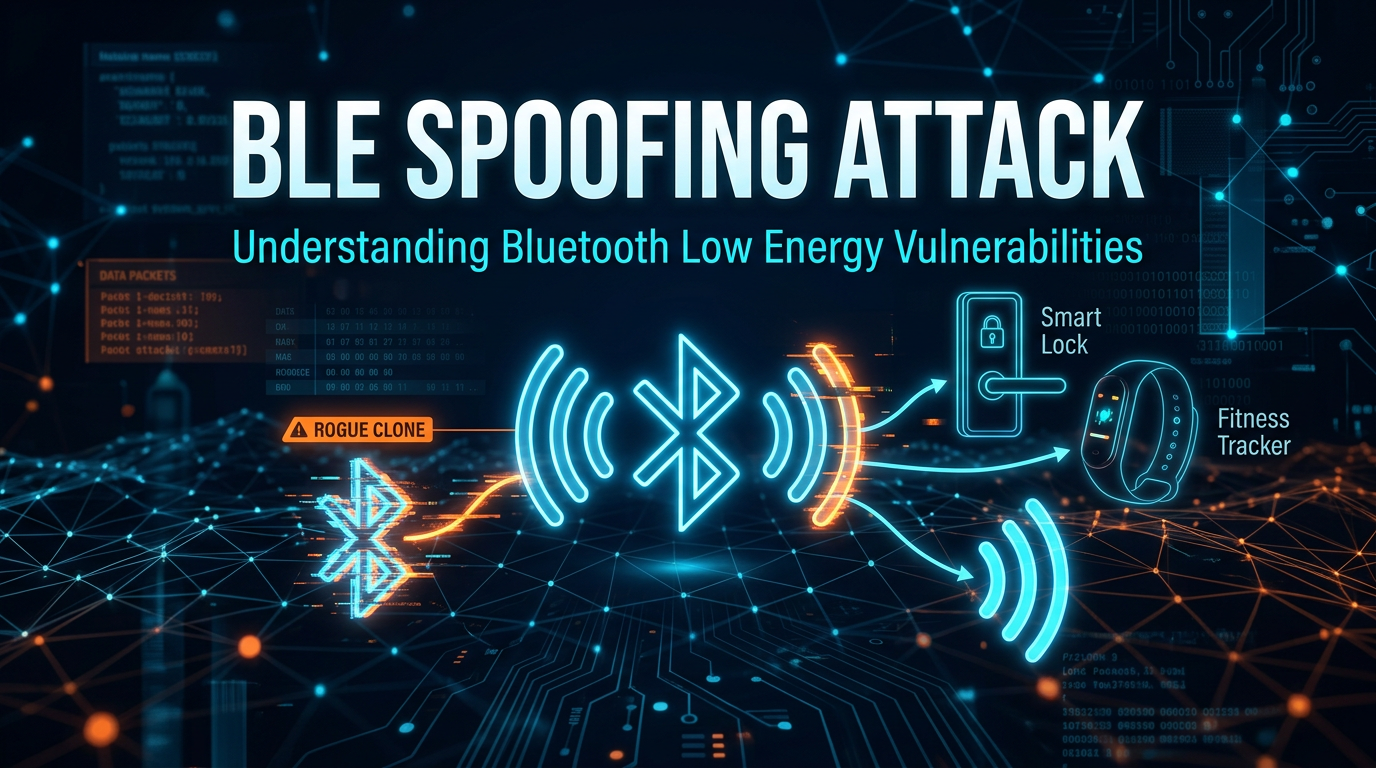
Bluetooth Low Energy (BLE) has become the backbone of the modern Internet of Things (IoT) ecosystem, powering everything from medical implants and smart locks to industrial sensors and fitness trackers. However, as these devices proliferate, they become prime targets for attackers who exploit the protocol's inherent trust models. BLE spoofing is a critical vulnerability where an attacker masquerades as a legitimate device to intercept data, inject commands, or bypass security controls.
Understanding Bluetooth Low Energy (BLE)
To understand spoofing, we must first understand how BLE operates. Unlike Bluetooth Classic, which was designed for continuous data streaming (like wireless headphones), BLE was engineered for low power consumption and intermittent data transmission. This is achieved through a specific protocol stack that prioritizes efficiency over constant connectivity.
The BLE Protocol Stack: GAP and GATT
Two core frameworks define how BLE devices interact: the Generic Access Profile (GAP) and the Generic Attribute Profile (GATT).
- GAP (Generic Access Profile): This layer controls the visibility and connection logic of the device. It determines how a device advertises its presence (Broadcaster/Observer roles) and how it establishes a connection (Peripheral/Central roles). In a spoofing scenario, an attacker manipulates GAP parameters to make a rogue device appear identical to a legitimate one.
- GATT (Generic Attribute Profile): Once a connection is established, GATT defines how data is organized and exchanged. It uses a hierarchical structure of Services and Characteristics, identified by Universally Unique Identifiers (UUIDs). For instance, a heart rate monitor might have a "Heart Rate Service" with a "Heart Rate Measurement Characteristic."
Advertising and Scanning
BLE devices spend most of their time in an "Advertising" state. A peripheral device sends out small packets of data (Advertising Data) on specific channels. These packets contain the device's MAC address, name, and supported services. A central device (like a smartphone) scans for these packets. Spoofing typically begins at this stage, where an attacker captures these advertising packets to replicate them.
What is BLE Spoofing?
BLE spoofing is an identity-based attack where a malicious actor clones the identity of a trusted BLE peripheral. By replicating the target device's MAC address and its GATT services, the attacker tricks a central device into connecting to the rogue hardware instead of the legitimate one.
Because many BLE implementations rely on "Just Works" pairing—a mechanism that provides no protection against Man-in-the-Middle (MitM) attacks—the central device often establishes a secure-looking connection without any user verification. This allows the attacker to act as a proxy, capturing sensitive data or sending unauthorized control signals to the real peripheral.
How BLE Spoofing Works: The Technical Mechanics
Spoofing is rarely a standalone event; it is often part of a larger attack chain involving reconnaissance and interception. Here is how the technical process unfolds.
1. Reconnaissance and MAC Address Cloning
Every BLE device has a 48-bit physical address (MAC address). While some devices use "Private Random Addresses" to prevent tracking, many IoT devices still use static or predictable addresses. An attacker can use tools like hcitool on Linux to find nearby targets:
sudo hcitool lescan
Once the target MAC address (e.g., AA:BB:CC:DD:EE:FF) is identified, the attacker can configure their own Bluetooth interface to use that same address. On a Linux machine with the BlueZ stack, this can be done as follows:
sudo hciconfig hci0 down
sudo btmgmt -i hci0 public-addr AA:BB:CC:DD:EE:FF
sudo hciconfig hci0 up
2. Replicating GATT Services
Simply having the same MAC address is often not enough to fool a sophisticated mobile application. The application will check for specific GATT services and characteristics. Attackers use tools like gatttool to enumerate the target's services:
gatttool -b AA:BB:CC:DD:EE:FF --primary
After mapping the UUIDs, the attacker uses a software-defined peripheral (often written in Python using libraries like BLESuite or Bleak) to host an identical GATT server. When the victim's phone connects, it sees the exact same services it expects from the legitimate device.
Tools for BLE Spoofing and Analysis
To perform BLE spoofing effectively, researchers and attackers use a combination of hardware and software designed for radio frequency (RF) manipulation.
Bettercap
Bettercap is a powerful, all-in-one tool for network attacks, including BLE. It can automate the process of scanning, enumerating, and spoofing BLE devices. Its BLE module allows for real-time interaction with discovered devices.
# Start bettercap and the BLE module
sudo bettercap
> ble.recon on
> ble.enum AA:BB:CC:DD:EE:FF
Ubertooth One
The Ubertooth One is an open-source 2.4 GHz wireless development platform specifically designed for Bluetooth experimentation. Unlike standard Bluetooth adapters, it can sniff BLE packets in the air without being connected to a device, making it invaluable for capturing advertising data and connection handshakes.
nRF Connect for Mobile
While not a hacking tool per se, nRF Connect is an essential utility for understanding BLE environments. It allows users to scan for devices, view their GATT structures, and even define custom advertising packets, which can be used for basic spoofing tests from one smartphone to another.
Step-by-Step Example: Spoofing a BLE Heart Rate Monitor
Imagine a scenario where a medical app relies on a BLE heart rate monitor to adjust medication dosage. An attacker wants to spoof this monitor to feed false data to the app.
- Capture Advertising Data: The attacker uses a sniffer to capture the advertising packet of the real monitor. They find the MAC address and the specific flags used in the packet.
- Set Up the Rogue Peripheral: Using a Python script, the attacker initializes a BLE peripheral on their laptop. They set the MAC address to match the monitor and define a GATT service with the UUID
0x180D(Heart Rate Service). - Define Characteristics: Within that service, they create a characteristic
0x2A37(Heart Rate Measurement). They set the properties toNotify, allowing them to push data to the app. - The Hijack: The attacker uses a signal jammer or simply moves closer to the victim's phone than the real monitor. The phone sees the "stronger" signal from the spoofed device and connects.
- Data Injection: The attacker sends a notification packet containing a heart rate of 180 BPM, even if the victim is resting. The app receives this spoofed data as if it came from the real sensor.
Real-World Scenarios and Impact
BLE spoofing isn't just a theoretical laboratory exercise; it has profound implications for physical and digital security.
Smart Locks and Physical Access
Many smart locks use BLE to detect when a user's phone is nearby. If the lock relies on simple proximity or unencrypted MAC address recognition, an attacker can spoof the user's phone. By replicating the phone's BLE identity, the attacker can trick the lock into opening, granting unauthorized physical access to a home or office.
Industrial IoT (IIoT) Sabotage
In industrial settings, BLE sensors monitor the temperature and vibration of heavy machinery. Spoofing these sensors can lead to catastrophic failure. An attacker could spoof a sensor to report normal operating temperatures while a machine is actually overheating, preventing safety protocols from triggering and causing physical damage.
Privacy and Tracking
BLE spoofing can also be used for "identity theft" in the context of contact tracing or retail tracking. By spoofing the BLE IDs of individuals, an attacker can generate fake location history data or confuse proximity-based tracking systems used in public health initiatives.
How to Prevent BLE Spoofing Attacks
Defending against BLE spoofing requires a multi-layered approach that moves beyond the basic security features provided by the Bluetooth specification.
1. Implementing LE Secure Connections (LESC)
Developers should avoid "Legacy Pairing" and instead use "LE Secure Connections," introduced in Bluetooth 4.2. LESC uses Elliptic Curve Diffie-Hellman (ECDH) for key exchange, which provides significantly stronger protection against eavesdropping and MitM attacks. It ensures that even if an attacker spoofs an identity, they cannot complete the encrypted handshake without the correct keys.
2. Application-Layer Encryption
Never trust the transport layer alone. Sensitive data should be encrypted at the application layer before it even reaches the BLE stack. By using libraries like AES or ChaCha20 to encrypt GATT characteristic values, you ensure that even if an attacker spoofs a device and establishes a connection, the data they intercept or attempt to inject remains useless without the application-level keys.
3. Out-of-Band (OOB) Pairing
OOB pairing uses a secondary communication channel, such as NFC or a QR code, to exchange security information. This eliminates the possibility of a spoofing attack during the initial discovery phase, as the devices have already exchanged cryptographic identities through a physical, short-range medium that an attacker cannot easily intercept remotely.
Conclusion
BLE spoofing highlights a fundamental truth in cybersecurity: identity is not the same as authentication. As our world becomes increasingly reliant on low-energy wireless communication, understanding the mechanics of how these signals can be mimicked is essential for both developers and security professionals. By moving toward robust encryption standards and avoiding default trust settings, we can secure the wireless perimeter against these stealthy intrusions.
To proactively monitor your organization's external attack surface and catch exposures before attackers do, try Jsmon.