What is AWS IAM Privilege Escalation? Ways to Exploit, Examples and Impact
Explore AWS IAM privilege escalation techniques, payloads, and impacts. Learn how to secure your AWS environment against identity-based attacks.
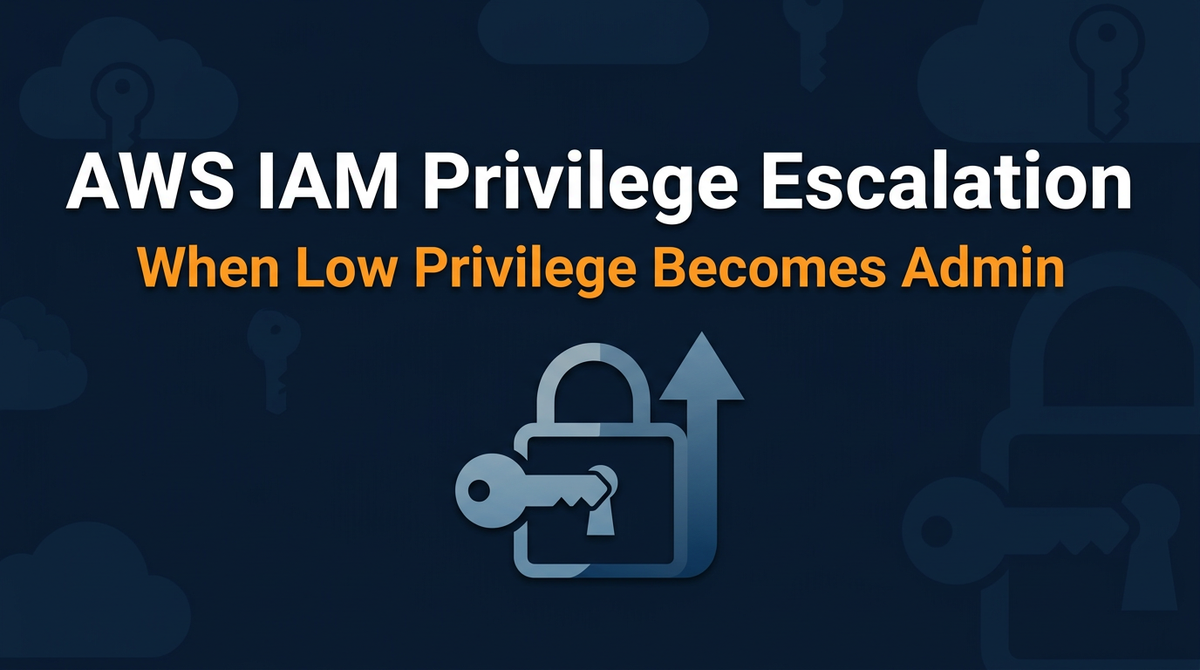
In the modern cloud landscape, identity is the new perimeter. As organizations migrate their infrastructure to Amazon Web Services (AWS), the Identity and Access Management (IAM) service becomes the most critical component of their security architecture. However, a single misconfigured permission can lead to a catastrophic event known as AWS IAM Privilege Escalation, where an attacker with limited access gains administrative control over an entire cloud environment.
Understanding AWS IAM and the Concept of Privilege Escalation
Before diving into the exploits, it is essential to understand what Jsmon users and security professionals mean by "IAM." AWS IAM is a web service that helps you securely control access to AWS resources. It allows you to manage who is authenticated (signed in) and authorized (has permissions) to use resources.
Privilege escalation (PE) occurs when a user or entity is able to gain a higher level of permissions than what was originally intended by the administrator. In AWS, this usually happens because of overly permissive IAM policies. There are two primary types of privilege escalation:
- Vertical Privilege Escalation: An attacker moves from a low-privileged account (e.g., a read-only auditor) to a high-privileged account (e.g., an Administrator).
- Horizontal Privilege Escalation: An attacker gains access to another user's account that has a similar level of privilege but different data access, effectively expanding their reach across the organization.
How AWS IAM Privilege Escalation Occurs
AWS uses a policy-based authorization system. Permissions are defined in JSON documents called policies, which are attached to IAM users, groups, or roles. If a policy contains a combination of permissions that allow a user to modify their own permissions or create new identities with more power, the door to escalation is wide open.
Attackers typically look for "primitive" permissions that can be chained together. For example, if you have the permission to create a new access key for any user, you can target the administrator, create a key for them, and then log in as that administrator.
Common Ways to Exploit AWS IAM Misconfigurations
There are dozens of known methods to escalate privileges in AWS. Let's explore some of the most common and technical examples that every cloud security enthusiast should know.
1. Creating a New Access Key (iam:CreateAccessKey)
This is perhaps the most straightforward method. If an attacker gains access to a user who has the iam:CreateAccessKey permission on other users, they can generate a new API key for a high-privileged user.
The Payload:
An attacker would use the AWS CLI to target an administrator user:
aws iam create-access-key --user-name admin-user-name
The Result:
The command returns an AccessKeyId and a SecretAccessKey. The attacker can now configure their CLI with these credentials and execute commands as the admin-user-name.
2. Creating or Updating a Login Profile (iam:CreateLoginProfile / iam:UpdateLoginProfile)
If an attacker has the permission to create or update a login profile, they can set or change the password for any user to gain console access.
The Payload:
aws iam create-login-profile --user-name target-admin --password 'NewPassword123!' --no-password-reset-required
If the login profile already exists, the attacker uses update-login-profile instead. This allows the attacker to bypass multi-factor authentication (MFA) if it is not strictly enforced at the policy level for that specific action.
3. Attaching or Putting Policies (iam:AttachUserPolicy / iam:PutUserPolicy)
This is the "holy grail" of direct escalation. If a user can attach a managed policy to themselves or put an inline policy on their own identity, they can simply grant themselves the AdministratorAccess policy.
The Payload (Attach):
aws iam attach-user-policy --user-name my-own-user --policy-arn arn:aws:iam::aws:policy/AdministratorAccess
The Payload (Put):
An attacker can create a custom inline policy that grants all actions on all resources:
{
    "Version": "2012-10-17",
    "Statement": [
        {
            "Effect": "Allow",
            "Action": "*",
            "Resource": "*"
        }
    ]
}
They then apply it using:
aws iam put-user-policy --user-name my-own-user --policy-name ExploitPolicy --policy-document file://policy.json
4. The "PassRole" and EC2 Trick (iam:PassRole + ec2:RunInstances)
This is a classic "indirect" privilege escalation. It involves the iam:PassRole permission, which allows a user to pass an IAM role to an AWS service (like EC2). If an attacker has iam:PassRole and ec2:RunInstances, they can launch a new EC2 instance, attach a high-privilege IAM role to it, and then access that instance to steal the role's temporary credentials.
The Workflow:
- Identify a powerful IAM role (e.g.,
CloudAdminRole) that has a Trust Relationship allowing EC2 to assume it. - Launch an EC2 instance and assign it the
CloudAdminRoleusing an Instance Profile. - SSH into the instance (or use User Data to exfiltrate data).
- Query the Instance Metadata Service (IMDS) to get the temporary credentials.
The Metadata Query:
curl http://169.254.169.254/latest/meta-data/iam/security-credentials/CloudAdminRole
5. Modifying Policy Versions (iam:SetDefaultPolicyVersion)
AWS allows you to have multiple versions of an IAM policy. Only one version is "Default" (active). If an attacker has iam:SetDefaultPolicyVersion, they can look through the history of a policy. If a previous version was overly permissive (perhaps an old admin policy that was later restricted), the attacker can switch the active version back to the insecure one.
The Payload:
aws iam set-default-policy-version --policy-arn arn:aws:iam::123456789012:policy/MyPolicy --version-id v2
The Impact of Successful Escalation
When an attacker successfully escalates privileges in AWS, the impact is often total and immediate. Because cloud environments are highly integrated, the fallout can include:
- Data Exfiltration: Access to S3 buckets containing sensitive customer data, PII, or intellectual property.
- Ransomware and Sabotage: Deleting backups, encrypting EBS volumes, or shutting down critical production databases (RDS).
- Resource Hijacking: Using the organization's compute power (EC2, Lambda) for crypto-mining, which can lead to massive financial bills.
- Persistence: Creating new IAM users, backdoored roles, or modifying Lambda functions to maintain access even after the initial entry point is closed.
- Lateral Movement: Using the cloud environment as a jumping-off point to attack on-premises networks connected via VPN or Direct Connect.
How to Prevent AWS IAM Privilege Escalation
Security is a continuous process. To protect your infrastructure, Jsmon recommends the following best practices:
Implement the Principle of Least Privilege (PoLP)
Never grant a user more permissions than they need to perform their job. Instead of using wildcards (*), specify the exact actions and resources required. Use AWS Managed Policies only when necessary, and prefer Customer Managed Policies for tighter control.
Use IAM Access Analyzer
AWS provides a built-in tool called IAM Access Analyzer. It can help you identify policies that grant public or cross-account access and can even generate fine-grained policies based on actual access logs (CloudTrail).
Monitor for High-Risk API Calls
Set up Amazon CloudWatch Alarms or AWS Config rules to alert your security team whenever sensitive IAM actions are performed, such as CreateAccessKey, PutUserPolicy, or UpdateLoginProfile.
Enforce Multi-Factor Authentication (MFA)
MFA should be mandatory for all users, especially those with any form of administrative privilege. Ensure your policies explicitly deny actions if the user has not authenticated with MFA.
Regular Audits and Reconnaissance
Tools like Jsmon can help you monitor your external attack surface. By understanding what assets are exposed, you can better prioritize which IAM roles and users need the most stringent auditing.
Conclusion
AWS IAM Privilege Escalation is a critical threat that stems from the complexity of modern cloud permissions. By understanding the common paths attackers take—such as policy manipulation, role passing, and credential creation—technical professionals can build more resilient environments. Remember, in the cloud, a single permission isn't just a setting; it's a potential key to the kingdom.
To proactively monitor your organization's external attack surface and catch exposures before attackers do, try Jsmon.