What is a Side-Channel Attack? Ways to Exploit, Examples and Impact
Discover how side-channel attacks exploit physical leakage to steal data. Learn about timing attacks, power analysis, and mitigation strategies.
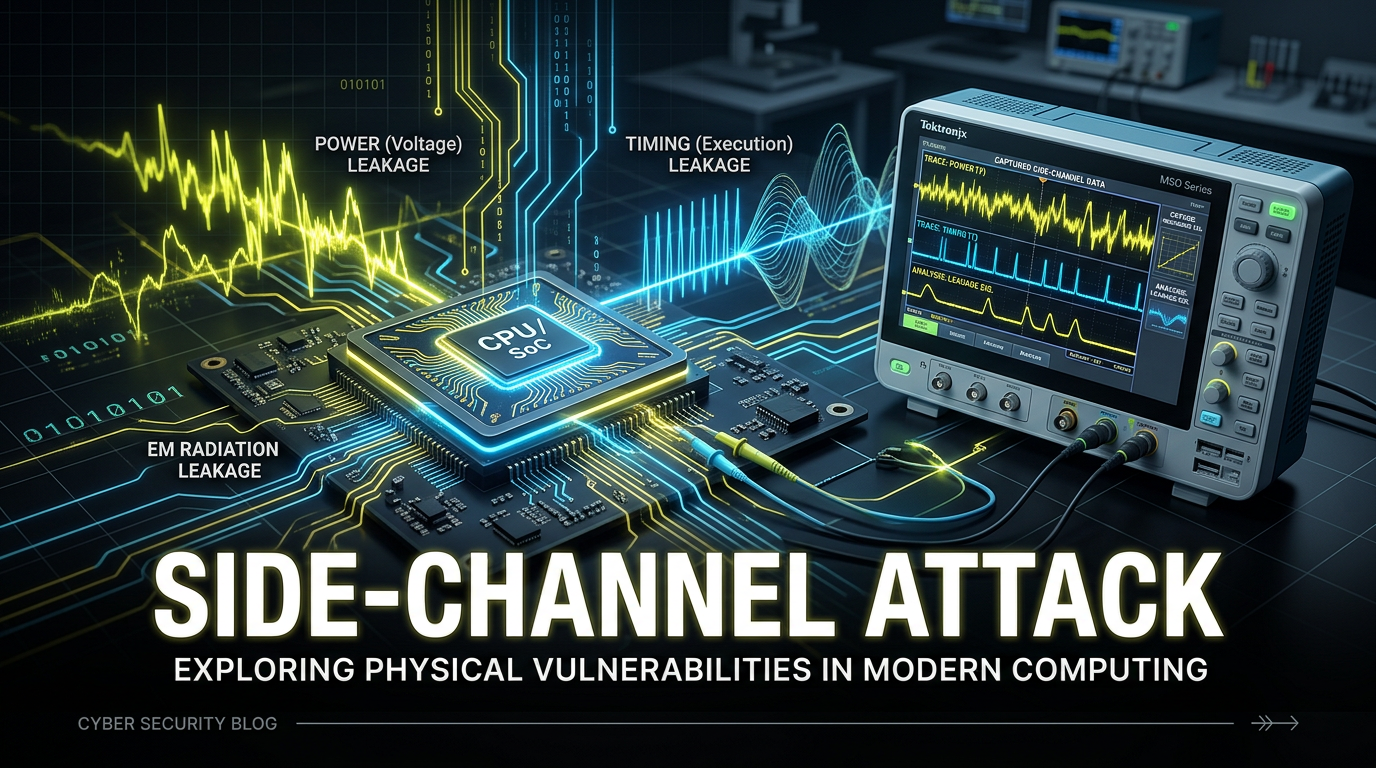
In the world of cybersecurity, we often focus on software vulnerabilities like buffer overflows, SQL injection, or broken authentication. However, there is a class of threats that bypasses the logic of the code entirely, targeting the physical implementation of the system instead. These are known as side-channel attacks (SCA), and they represent some of the most sophisticated and fascinating methods used to extract sensitive information from otherwise secure hardware and software.
What is a Side-Channel Attack?
A side-channel attack is a security exploit that attempts to extract secrets from a chip or a system by measuring physical outputs rather than attacking the software's logical vulnerabilities. While traditional cryptanalysis focuses on finding mathematical weaknesses in an algorithm (like AES or RSA), a side-channel attack looks at the "side effects" of the algorithm's execution.
Think of it like trying to crack a safe. A traditional attacker might try to guess the combination or find a flaw in the lock's design. A side-channel attacker, however, might use a stethoscope to hear the clicks of the tumblers or measure the heat generated by the friction of the dial. In computing, these "clicks" translate to power consumption, execution time, electromagnetic radiation, or even sound. For organizations managing complex infrastructure, understanding these physical leaks is critical to maintaining a robust security posture, often supplemented by tools like Jsmon for external visibility.
How Side-Channel Attacks Work
Every electronic operation involves the movement of electrons. This movement has physical consequences: it takes time, it consumes energy, and it emits heat and radiation. Because the specific data being processed influences how many transistors flip and how long an operation takes, these physical properties often correlate directly with the data itself.
If an attacker can observe these correlations, they can reverse-engineer the data being processed—even if that data is an encrypted private key. Side-channel attacks are particularly dangerous because they do not leave traces in system logs and often cannot be detected by standard antivirus or Intrusion Detection Systems (IDS).
Common Types of Side-Channel Attacks
Side-channel attacks come in many forms, depending on what physical property is being measured. Here are the most prevalent types encountered in the field today.
1. Timing Attacks
Timing attacks are perhaps the most accessible form of side-channel exploitation. They rely on the fact that different operations in a computer take different amounts of time to complete. If a cryptographic algorithm takes 10 milliseconds to process a '0' bit and 12 milliseconds to process a '1' bit, an attacker can determine the key by measuring the total execution time.
Example: Vulnerable String Comparison
Consider a simple password verification function. A naive implementation might use a non-constant-time string comparison:
def insecure_verify(input_password, actual_password):
    if len(input_password) != len(actual_password):
        return False
    for i in range(len(actual_password)):
        if input_password[i] != actual_password[i]:
            return False # Returns early on mismatch
    return True
In the code above, the function returns False as soon as it finds a character that doesn't match. An attacker can measure how long the function takes to execute. If the first character is wrong, it returns very quickly. If the first three characters are correct, it takes slightly longer before returning False. By iterating through characters and measuring the time difference, an attacker can guess the password one character at a time.
2. Power Analysis Attacks
Power analysis involves measuring the electrical current used by a device (like a smart card or a hardware security module) during cryptographic operations. There are two main sub-types:
- Simple Power Analysis (SPA): The attacker directly observes a power trace. For example, in RSA encryption, the "square" and "multiply" operations look different on a graph. By looking at the spikes in power, an attacker can read the private key bits directly.
- Differential Power Analysis (DPA): This is more advanced and uses statistical methods to analyze multiple power traces. By correlating power consumption with guessed bits of a key, an attacker can filter out noise and extract the actual key even if individual traces are messy.
3. Electromagnetic (EM) Attacks
Electronic devices emit electromagnetic radiation. By placing a sensitive antenna near a CPU or a mobile phone, an attacker can capture these signals. Similar to power analysis, these signals fluctuate based on the data being processed. The advantage of EM attacks is that they can often be performed non-invasively, without even touching the target device.
4. Cache-Based Side-Channel Attacks
In modern processors, the CPU uses a "cache" to store frequently accessed data for speed. However, because the cache is shared between different processes, one process can observe how long it takes to access its own data to determine what another process is doing. If a victim process accesses a specific memory address, it might evict the attacker's data from the cache. When the attacker tries to access their data and finds it slow (a "cache miss"), they know exactly which memory block the victim accessed.
Real-World Examples and Exploits
To understand the gravity of these attacks, we must look at how they have been applied in the real world against major technologies.
Spectre and Meltdown
Discovered in 2018, Spectre and Meltdown are perhaps the most famous examples of microarchitectural side-channel attacks. They exploit "speculative execution," a feature where CPUs guess which instructions will be executed next to improve performance.
Spectre uses a cache-based side-channel to leak data from other applications' memory. Even though the CPU eventually realizes it made a wrong guess and discards the result, the state of the cache remains changed. An attacker can use a "Flush + Reload" technique to see which memory locations were speculatively accessed, effectively reading secrets from the kernel or other processes.
Acoustic Cryptanalysis
In a surprising 2013 research paper, scientists demonstrated that they could extract RSA keys from a laptop by listening to the high-pitched "whine" produced by the CPU's voltage regulator. As the CPU changes its power state to perform different mathematical operations, the capacitors vibrate, creating a sound that can be picked up by a high-quality microphone placed nearby.
Heartbleed (Timing Variant)
While the original Heartbleed vulnerability was a buffer over-read, researchers later found that timing variations in how OpenSSL handled the error could potentially be used to identify whether certain data existed in memory, adding a side-channel layer to an already devastating software bug.
The Impact of Side-Channel Attacks
The impact of a successful side-channel attack is often total compromise. Because these attacks target the foundation of trust—the cryptographic keys—the consequences are severe:
- Loss of Confidentiality: Encrypted communications, stored passwords, and sensitive personal data can be decrypted in plain sight.
- Hardware Devaluation: If a hardware security chip (like a TPM) is found to be vulnerable to power analysis, every device using that chip becomes untrustworthy, often requiring physical replacement.
- Bypassing Sandboxes: Cache attacks allow malicious code in a low-privilege environment (like a web browser) to read data from high-privilege environments (like the operating system kernel).
- Undetectability: Since the attacker is merely "observing" physical properties, there is no log entry, no failed login attempt, and no suspicious network packet to trigger an alert.
How to Prevent and Mitigate Side-Channel Attacks
Defending against side-channel attacks is difficult because it often requires changing how hardware is built or how low-level code is written. However, several strategies are effective:
Constant-Time Programming
The most effective way to stop timing attacks is to ensure that cryptographic functions take exactly the same amount of time regardless of the input. This means avoiding conditional branches (if/else) that depend on secret data.
Secure Example:
def secure_compare(a, b):
    if len(a) != len(b):
        return False
    result = 0
    for x, y in zip(a, b):
        result |= ord(x) ^ ord(y)
    return result == 0
In this secure version, the loop always runs for the full length of the string, and the bitwise XOR operation ensures no early exit occurs.
Blinding and Masking
Blinding is a technique used in RSA where the input data is multiplied by a random factor before being processed. After the operation is complete, the random factor is removed. Because the CPU is processing randomized data, the power consumption and timing no longer correlate with the actual secret key.
Hardware Shielding
Physical devices can be shielded with metal enclosures to prevent EM leakage. Additionally, engineers can add "noise" to power lines or use dual-rail logic, where every operation consumes a constant amount of power by flipping a dummy transistor for every real one flipped.
Disabling High-Resolution Timers
For web-based cache attacks (like Spectre), browser vendors have mitigated the risk by reducing the precision of JavaScript timers (e.g., performance.now()). If the attacker cannot measure time with nanosecond precision, they cannot distinguish between a cache hit and a cache miss.
Conclusion
Side-channel attacks remind us that security is not just a mathematical problem, but a physical one. As our devices become smaller and more powerful, the "noise" they produce becomes a signal for those who know how to listen. While these attacks were once the domain of nation-state actors with expensive laboratory equipment, the rise of cloud computing and shared hardware has made microarchitectural attacks a concern for everyone.
Staying ahead of these threats requires a defense-in-depth strategy that combines secure coding practices with rigorous infrastructure monitoring. Understanding your attack surface is the first step in defending it.
To proactively monitor your organization's external attack surface and catch exposures before attackers do, try Jsmon.